|
|
|
• Uniform • Galvanic • Dealloying • Crevice • Pitting • SSC • LME • MIC • SCC • HB-HE-HIC-HMx • Fatigue • Erosion • Stray Current • Index |
|
Different Types of
Corrosion
|
|
Galvanic Corrosion, Bimetallic Corrosion or
Dissimilar Metal Corrosion: Causes and Prevention
|
|
|
Galvanic Corrosion Recognition |
|
|
The less corrosion resistant or the "active" member of the couple experiences accelerated corrosion while the more corrosion resistant or the "noble" member of the couple experiences reduced corrosion due to the "cathodic protection" effect.
The most severe attack occurs at the joint between the two dissimilar metals. Further away from the bi-metallic joint, the degree of accelerated attack is reduced.
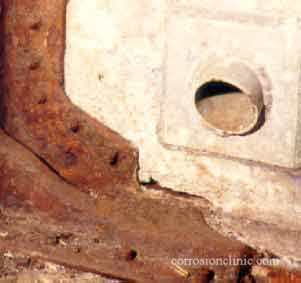
In this photo, a 5-mm thick aluminum alloy plate is physically (and hence, electrically) connected to a 10-mm thick mild steel structural support. Galvanic corrosion occurred on the aluminium plate along the joint with the mild steel. Perforation of aluminum plate occurred within 2 years due to the huge acceleration factor in galvanic corrosion.
|
|
|
Galvanic Corrosion Mechanisms |
|
|
What causes galvanic corrosion? Different metals and alloys have different electrochemical potentials (or corrosion potentials) in the same electrolyte. When the corrosion potentials of various metals and alloys are measured in a common electrolyte (e.g. natural seawater) and are listed in an orderly manner (descending or ascending) in a tabular form, a Galvanic Series is created. It should be emphasized that the corrosion potentials must be measured for all metals and alloys in the same electrolyte under the same environmental conditions (temperature, pH, flow rate etc.), otherwise, the potentials are not comparable.
The potential difference (i.e., the voltage) between two dissimilar metals is the driving force for the destructive attack on the active metal (anode). Current flows through the electrolyte to the more noble metal (cathode) and the less noble (anode) metal will corrode. The conductivity of electrolyte will also affect the degree of attack. The cathode to anode area ratio is directly proportional to the acceleration factor.
|
|
|
Galvanic Corrosion Prevention |
|
|
How to prevent galvanic corrosion? Galvanic corrosion can be prevented through a number of methods:
|
|
|
Galvanic Corrosion
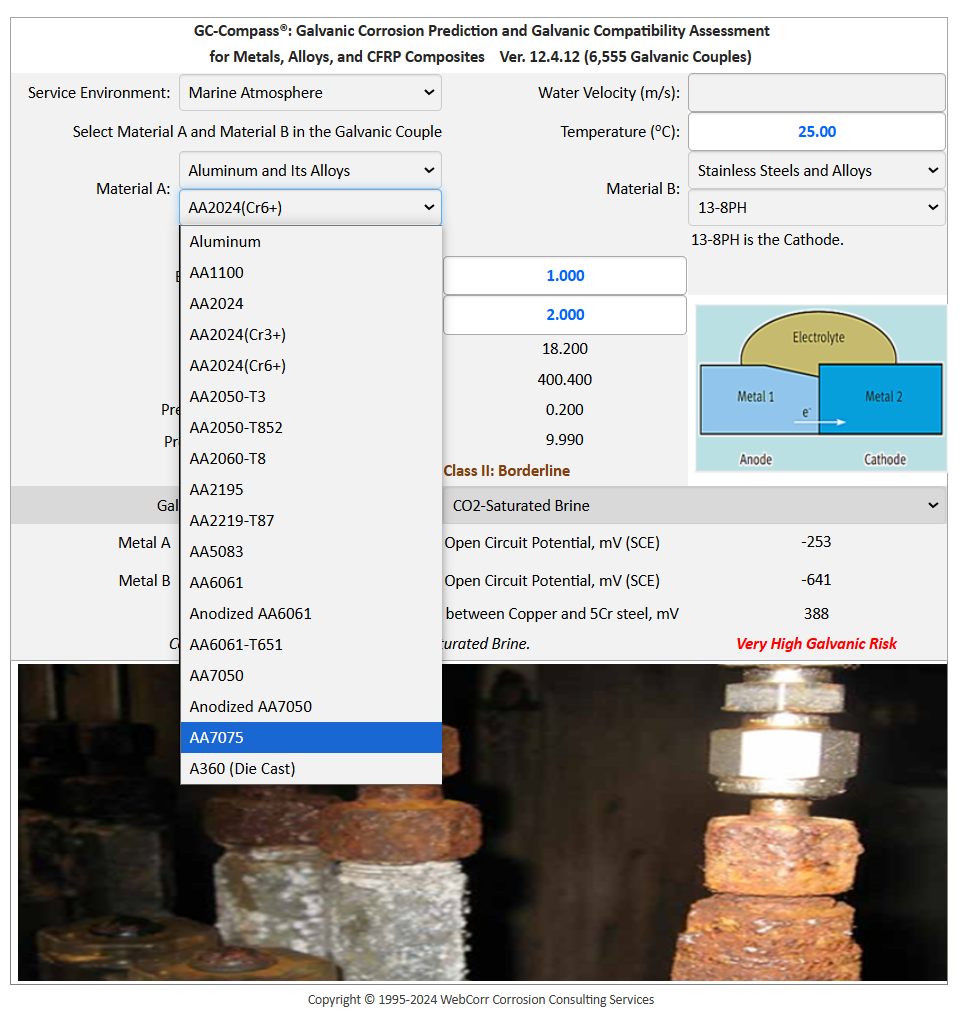
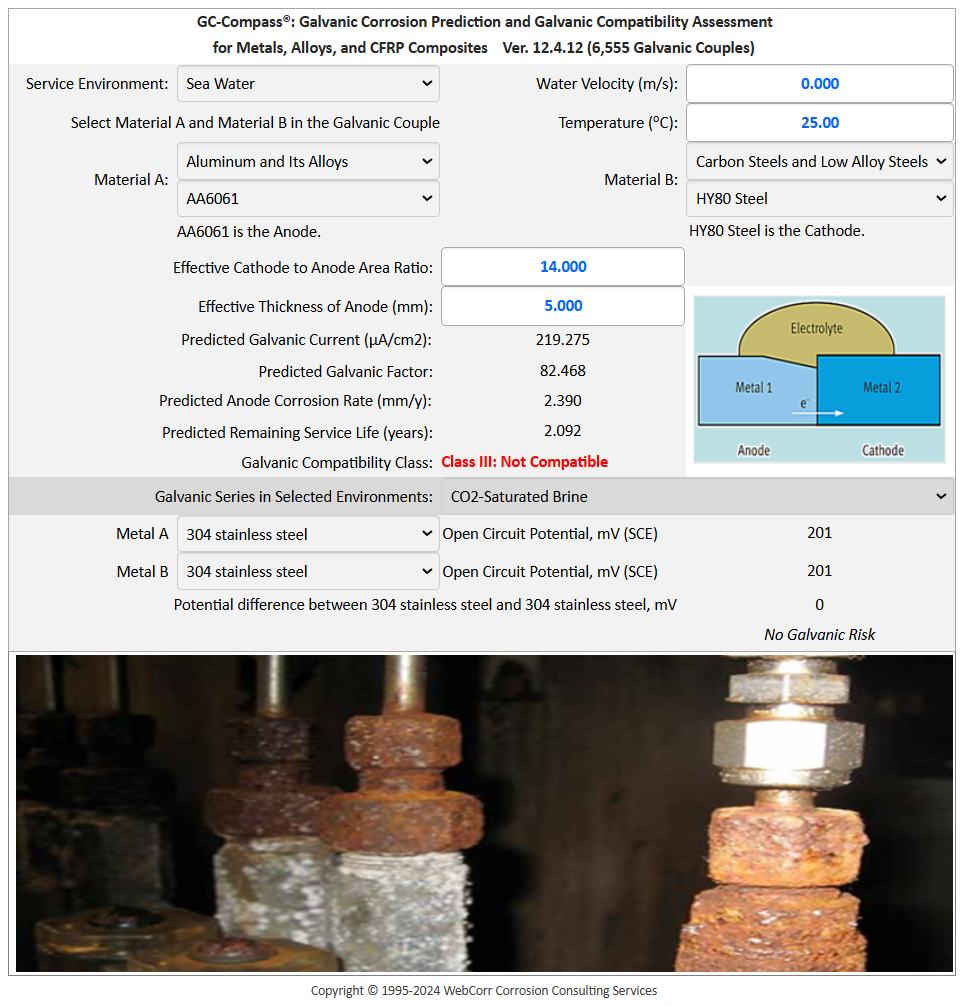
Modeling, Prediction and Evaluation GC-Compass®: A Software Tool for Galvanic Corrosion Prediction and Materials Galvanic Compatibility Assessment GC-Compass is the only device and OS independent software tool on the market for the prediction of galvanic corrosion and assessment of materials galvanic compatibility. Designers, engineers, architects, consultants, maintenance and inspection personnel can quickly assess and quantify the impact of galvanic coupling of dissimilar metals on the remaining life of their components or systems anytime, anywhere, on any device running any OS without the need to install or download anything. More detailed informatiion on GC-Compass is available here.
Over 200 galvanic couples are included in GC-Compass, the computer software for galvanic corrosion modeling, prediction and materials compatibility assessment.
Outputs from the software include the predicted galvanic corrosion rate of the anode member of the galvanic couple, the remaining life of the anode, and the galvanic compatibility class.
|
|
|
For more details on Galvanic Corrosion - Causes and Its Prevention |
|
|
More details on Galvanic Corrosion or Bimetallic Corrosion are included in the following corrosion courses which you can take as in-house training courses, course-on-demand, online courses or distance learning courses worldwide:
If you require corrosion expert witness or corrosion consulting service on galvanic corrosion, our NACE certified Corrosion Specialist is able to help. Contact us for a quote. |
|
|
Home | Go to Top | Contact Us | PDF |
Copyright © 1995-2024. All rights reserved. |