|
|
|
• Galvanic • Crevice • Pitting • Intergranular • Weld Decay • Knife-Line Attack • Exfoliation • SSC • LME • MIC • SCC • HB-HE-HIC • Index |
|
Different Types of
Corrosion
|
|
Intergranular Corrosion: Knife-Line Attack (KLA) |
|
|
Recognition of Knife-Line Attack |
|
|
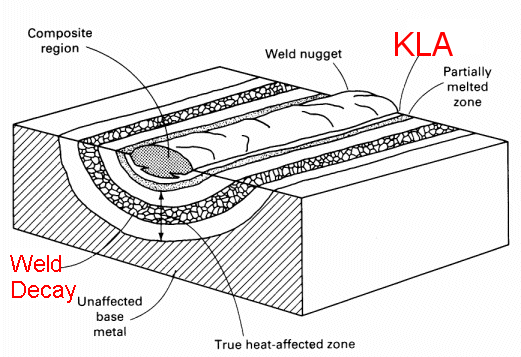
The corrosive attack is restricted to extremely narrow line adjoining the fusion line. Attack appears razor-sharp (and hence the name of "knife-line" attack). It is possible to visually recognize knife-line attack if the lines are already formed the along the weld.
|
|
|
Mechanisms of Knife-Line Attack |
|
|
What causes knife-line attack?
For stabilized stainless steels and alloys, carbon is bonded with stabilizers (Ti or Nb) and no weld decay occurs in the heat affected zone during welding. In the event of a subsequent heat treatment or welding, however, precipitation of chromium carbide is possible and this leaves the narrow band adjacent to the fusion line susceptible to intergranular corrosion.
|
|
|
Prevention of Knife-Line Attack |
|
|
How to prevent knife-line attack? Knife-Line Attack can be prevented through:
|
|
|
For more details on Knife-Line Attack |
|
|
Where can I learn more about knife-line attack? More details on knife-line attack and weldment corrosion are included in the following corrosion courses which you can take as in-house training courses, course-on-demand, online courses or distance learning courses:
If you require corrosion expert witness or corrosion consulting service on knife-line attack, our NACE certified Corrosion Specialist is able to help. Contact us for a quote. |
|
|
Home | Subject Index | Contact Us | PDF |
Copyright © 1995-2024. All rights reserved. |