|
|
|
• Galvanic • Crevice • Pitting • Intergranular • Weld Decay • Knife-Line Attack • Exfoliation • SSC • LME • MIC • SCC • HB-HE-HIC • Index |
|
Different Types of
Corrosion
|
|
Intergranular Corrosion: Exfoliation Corrosion |
|
|
Recognition of Exfoliation Corrosion |
|
|
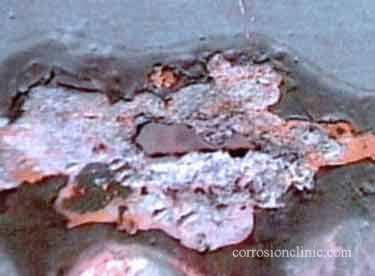
How to identify exfoliation? Exfoliation is sometimes described as lamellar, layer, or stratified corrosion. In this type of corrosion, attack proceeds along selective subsurface paths parallel to the surface. It is possible to visually recognize this type of corrosion if the grain boundary attack is severe otherwise microstructure examination under a microscope is needed.
|
|
|
Mechanisms of Exfoliation Corrosion |
|
|
What causes exfoliation? Exfoliation is a special type of intergranular corrosion that occurs on the elongated grain boundaries. The corrosion product that forms has a greater volume than the volume of the parent metal. The increased volume forces the layers apart, and causes the metal to exfoliate or delaminate. Aluminum alloys are particularly susceptible to this type of corrosion.
|
|
|
Prevention of Exfoliation Corrosion |
|
|
How to prevent exfoliation corrosion? Exfoliation corrosion can be prevented through:
|
|
|
For more details on Exfoliation Corrosion |
|
|
Where can I learn more about exfoliation corrosion? More details on exfoliation corrosion are included in the following corrosion courses which you can take as in-house training courses, course-on-demand, online courses or distance learning courses:
If you require corrosion expert witness or corrosion consulting service on exfoliation corrosion, our NACE certified Corrosion Specialist is able to help. Contact us for a quote. |
|
|
Home | Subject Index | Contact Us | PDF |
Copyright © 1995-2024. All rights reserved. |