|
|
|
• EC • Season Cracking • Caustic Embrittlement • Intergranular • SSC • LME • MIC • SCC • HB-HE-HIC • FAC • Erosion • Fretting • Index |
|
Different Types of
Corrosion
|
|
Erosion Corrosion |
|
|
Recognition of Erosion Corrosion |
|
|
What is Erosion Corrosion? Erosion Corrosion refers to the combined action involving erosion and corrosion in the presence of a moving corrosive fluid or a metal component moving through the fluid, leading to accelerated loss of metal.
|
|
|
Mechanisms of Erosion
Corrosion |
|
|
What causes Erosion Corrosion?
The mechanical effect of flow or velocity of a fluid combined with the corrosive action of the fluid causes accelerated loss of metal. The initial stage involves the mechanical removal of a metal's protective film and then corrosion of bare metal by a flowing corrosive occurs. The process is cyclic until perforation of the component occurs.
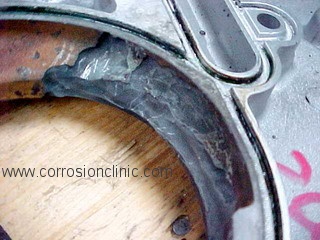
Erosion-corrosion is usually found at high flow rates around tube blockages, tube inlet ends, or in pump impellers. The photo shows erosion corrosion of a cast aluminum pump casing due to excessively high flow rate of the coolant.
What is the difference between Erosion Corrosion and Cavitation? Cavitation-corrosion is a special form of erosion-corrosion. It is caused by water bubbles produced by a high-speed impeller, which then collapse and cause pits on the metal surface.
What is the difference between Erosion Corrosion and Flow-Accelerated Corrosion? In the corrosion literature, erosion corrosion and flow-accelerated corrosion have been frequently used interchangeably. There does not exit a well-defined boundary between the two. Some argue that there is a subtle difference between Erosion Corrosion and Flow-Accelerated Corrosion. In FAC, fluid flow removes magnetite (Fe3O4) layer, exposing steel to corrosion, leading to wall thinning. There is no or thinner magnetite on surface at FAC location due to the flow effect than at locations not subjected to FAC. Click the FAC link for details.
|
|
|
Prevention and Prediction
of Erosion Corrosion |
|
|
How to prevent Erosion Corrosion? Erosion corrosion can be prevented through:
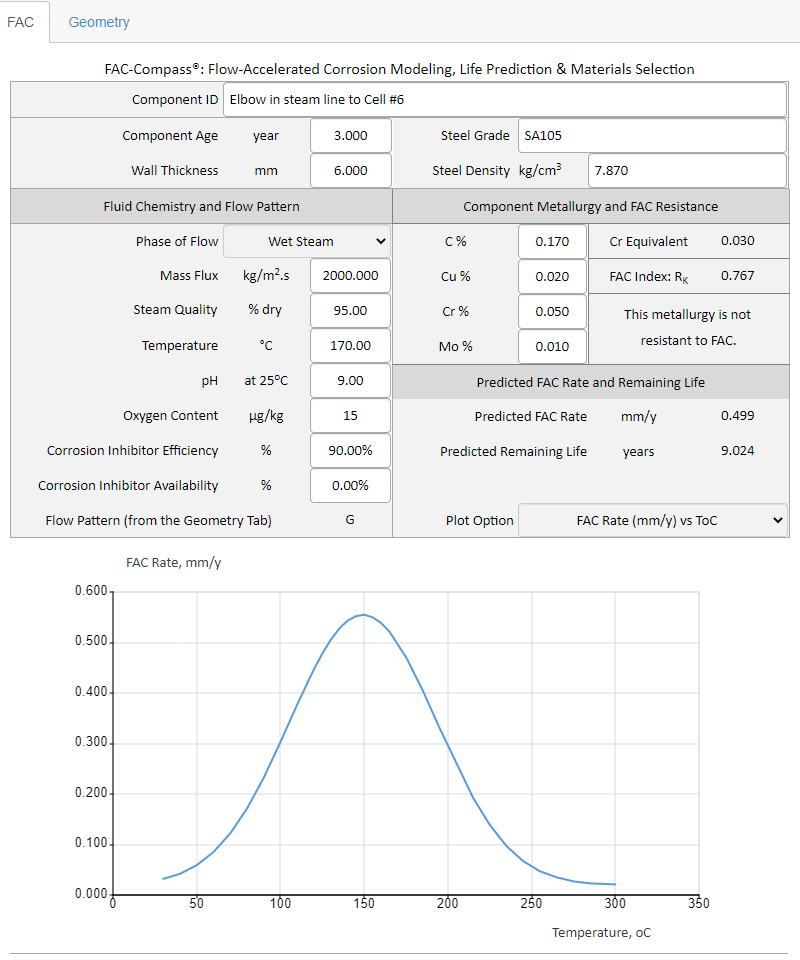
FAC-Compass is a powerful software tool for Erosion Corrosion/Flow-Accelerated Corrosion Modeling, Life Prediction and Materials Selection in Water-Steam Systems. Click this link for details on the features and functions of the latest version of FAC-Compass for predictive modeling and remaining life prediction.
|
|
|
For more details on Erosion
Corrosion |
|
|
More details on Erosion Corrosion are included in the following corrosion courses which you can take as in-house training courses, course-on-demand, online courses or distance learning courses:
If you require corrosion expert witness or corrosion consulting service on erosion corrosion, our NACE certified Corrosion Specialist is able to help. Contact us for a quote. |
|
| Home | Subject Index | Contact Us | PDF |
Copyright © 1995-2024. All rights reserved. |