|
 |
|
Consulting |
Training |
Expert Witness |
Failure Analysis |
Design Review |
Corrosion Test |
Corrosion Software |
Protective Coatings |
Materials Selection |
Cathodic Protection |
>>> |
|
|
The Corrosion Times
Local and International News on Corrosion
|
|
General Motors recalls more than 680,000 vehicles due to windshield wipers  defect
CNN, Sat April 2, 2022
New York (CNN)- General Motors is recalling
more than 680,000 SUVs due to a defect in their windshield wipers.
The 2014 to 2015 Chevrolet Equinox and GMC Terrain vehicles are being
recalled because the the windshield wipers could fall, due to the chance of
its ball joints corroding or wearing away.
The action covers 681,509 units, according
to a release by the National Highway Traffic Safety Administration, which
added that an estimated 1% of cars have the defect.
"General Motors is voluntarily recalling certain 2014-2015 model year
Chevrolet Equinox and GMC Terrain vehicles to replace the front windshield
wiper-modules in these vehicles," said Daniel Flores, a GM communications
manager.
The NHTSA said owners will receive
notification letters on May 2. Dealers will repair or replace the windshield
wipers at no cost to the SUVs' owners.
GM issued the same recall in 2017 for the 2013 Chevrolet Equinox and GMC
Terrain, saying at the time that ball joints in the compact SUVs' windshield
wipers "may experience high corrosion."
WebCorr offers a 2-day training course entitled "Corrosion
in Automotive Systems - Causes and Prevention". Click here for the course
outline.
|
|
17-year-old dies after basketball hoop structure in Bedok falls on him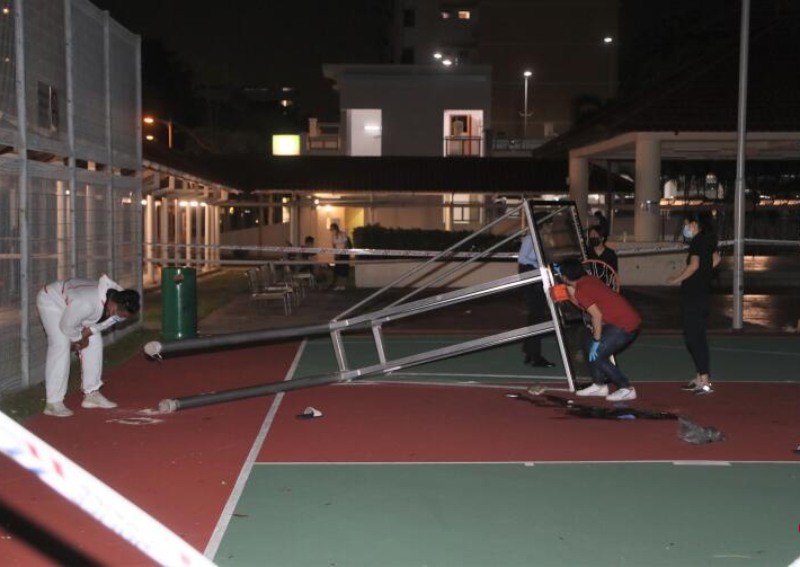
Asiaone, July 27, 2021
A game of basketball with friends ended on a tragic note for a teen on
Monday (July 26) night.
The
hoop structure at a basketball court near Block 18 Bedok South Road
collapsed and fell on him, gravely injuring the 17-year-old.
The Singapore Civil Defence Force told AsiaOne they received a call for
assistance at about 8.45pm.
Paramedics performed cardiopulmonary resuscitation on the teen while taking
him to Changi General Hospital.
"A
17-year-old male teenager was unconscious when conveyed to the hospital,
where he subsequently died from his injuries," the police said.
Investigations into the unnatural death are ongoing.
[WebCorr
comment: A similar incident occurred in March 2003:
Boy hit on head by lamp post dies, The Straits Times Wednesday, 7 March 2003.
Computer modeling software,
Soil-Compass for modeling and prediction of corrosion of
metals and alloys in soil environment can provide early indication of the
metal loss due to corrosion BEFORE catastrophic failure occurs.]
|
|
Surfside Condo Collapse: 97 Victims Identified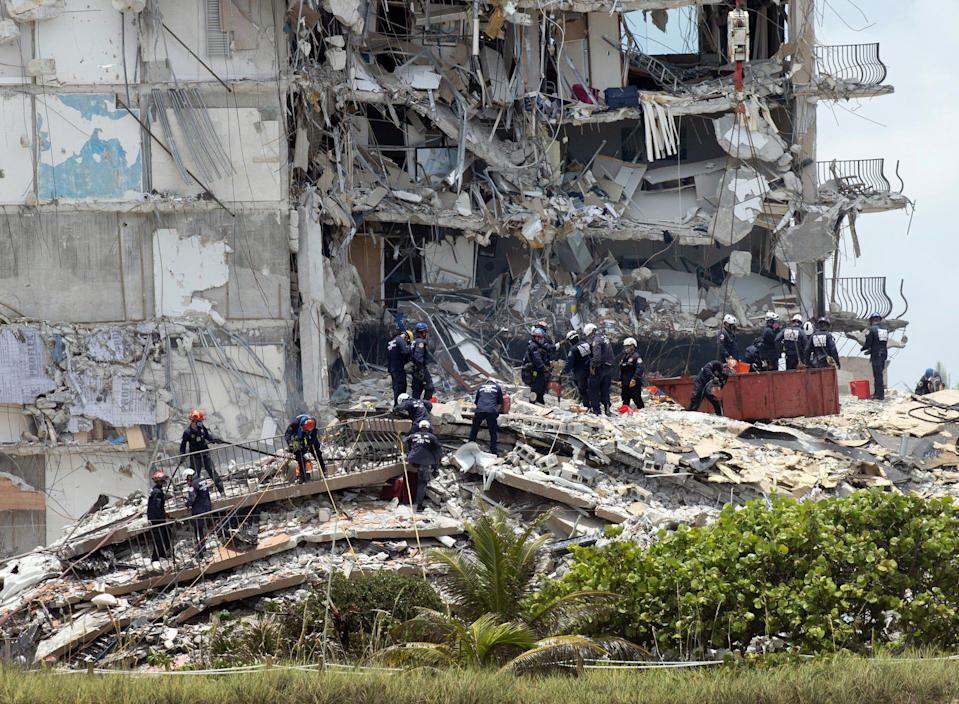
July 24, Saturday 2021, CNN
Authorities have identified 97 victims including 96 who were recovered from
the collapse site and one who died in the hospital, Miami-Dale County
officials said Wednesday.
Miami condo collapse: Death toll rises to 5 as rescuers race to find
survivors
26 June, Saturday 2021, Channel News Asia
SURFSIDE, Florida: Florida officials continued to hold out hope on Saturday
(Jun 26) for survivors of a high-rise apartment building that partially
collapsed three years after an engineer had warned of "major structural
damage." But fire was complicating the increasingly desperate effort to find
156 people still unaccounted for more than two days after part of the
building pancaked into a mountain of debris.
"We're facing incredible difficulties with this fire," Miami-Dade County
mayor
Daniella Levine Cava told reporters early
Saturday. She said workers dug a trench through the debris to control the
"very deep" blaze, but that smoke had spread throughout the site. But, she
added: "We continue to have hope. We're continuing
to search. We're looking for people alive in
the rubble, that is our priority and our teams have not stopped."
Five people have been confirmed dead after the 12-story oceanfront building
in
Surfside, near Miami Beach, collapsed as residents slept inside early
Thursday.
The fifth body was found on Saturday, a local official said.
"Today our search and rescue teams found another body in the rubble and as
well, our search has revealed some human remains," Miami-Dade County mayor
Daniella Levine Cava said at a news conference.
With the identification of three previously recovered bodies, "it means that
the unaccounted is now gone down to 156, confirmed deaths are now at a total
of five," she said.
Cava said Saturday that the casualty numbers were unchanged from the day
before.
Still, the passage of time with no further survivors being found raised
fears of a much higher death toll as rescuers sift through the debris with
heavy machinery and sniffer dogs, and as increasingly frustrated families
continued their agonising wait.
"ABUNDANT" CRACKING
Authorities and experts have stressed that the causes for Champlain Tower
South's collapse are still unknown. But the report of an engineering
consultancy that studied the building in 2018, released late Friday by
officials, underlined early concerns. It said its inspectors found "major
structural damage" to the concrete slab below a ground-level pool deck and
"abundant" cracking and crumbling in the parking garage. "Failure to replace
the waterproofing in the near future will cause the extent of the concrete
deterioration to expand exponentially," warned the report, from the Morabito
Consultants firm.
Most of the damage was "probably caused by years of exposure to the
corrosive salt air along the South Florida coast," it said. The report did
not indicate that the 40-year-old building risked collapse, but said it
needed repairs to maintain "structural integrity."
[WebCorr's comment: Computer modeling software,
Concrete-Compass for modeling and prediction of concrete
corrosion indicated that significant corrosion of reinforcing steels would
have already occurred in the building by the early 1990s due to frequent
seawater flooding.]
|
|
Death Toll Rises to 2 People From Baltimore Gas Explosion
ABC News, 12 August 2020
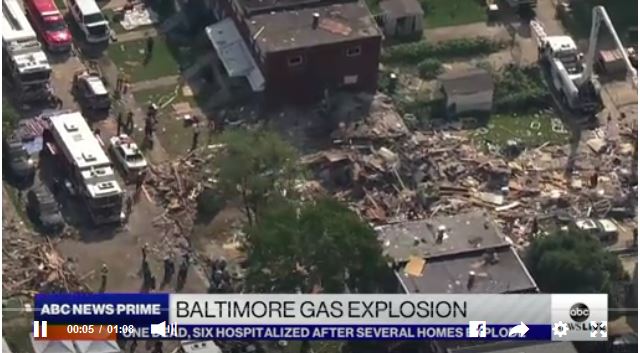
BALTIMORE -- Two people are now confirmed dead following a natural gas
explosion that destroyed three row houses in Baltimore and sent seven people
to the hospital, authorities said Tuesday.
More than 200 people in the neighborhood were affected by the blast, and
about 30 have utilized temporary shelter since the explosion, she said.
The natural gas explosion leveled three row houses and ripped open a fourth,
trapping people in the debris and scattering shards of glass and other
rubble over the northwest Baltimore neighborhood of Reisterstown Station.
Dozens of firefighters converged on the scene to free the injured.
The
Baltimore Sun reported last year that dangerous gas leaks have become much
more frequent, with nearly two dozen discovered each day on average,
according to the utility's reports to federal authorities. BGE has said it
has thousands of miles of obsolete pipes that need to be replaced, an effort
that would cost nearly $1 billion and take two decades, the newspaper said.
Founded in 1816, BGE is the oldest gas distribution company in the nation.
Like many older gas systems, a larger portion of its gas main and services
infrastructure consists of cast iron and bare steel materials that are obsolete and susceptible to failure with age, the PSC
wrote in a 2018 order approving a modernization plan.
This area's gas infrastructure was installed in the early 1960s. When aging
pipes fail, they tend to make headlines. Last year, a gas explosion ripped
the facade off a Maryland office complex in Columbia, affecting more than 20
businesses. No one was injured in the explosion early on a Sunday morning.
In 2016, a gas main break forced the evacuation of the Baltimore County
Circuit Courthouse. Under Armour Inc. had to evacuate its Baltimore office
after a gas main break in 2012.
|
U.S. FAA Issues Emergency Directive on
2,000 Boeing 737s Parked in Pandemic
Reuters, Thursday, July 24, 2020
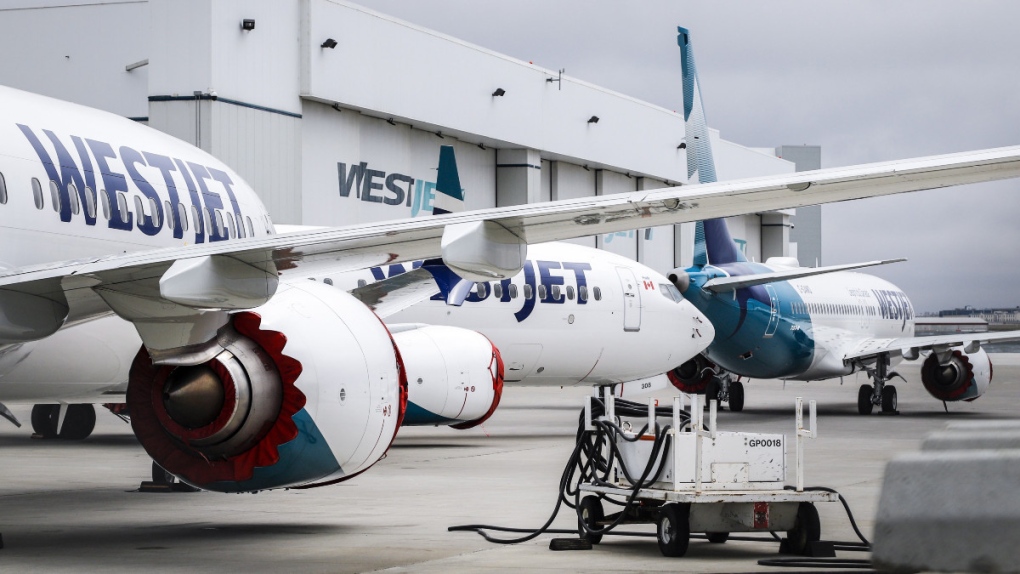
WASHINGTON
- Safety regulators issued an emergency order directing airlines to inspect
and if necessary replace a critical engine part on popular Boeing 737 jets
after four reports of engines shutting down during flights. The Federal
Aviation Administration said Friday that its order affected about 2,000
twin-engine passenger jets in the United States.
The FAA said operators must inspect any 737 that has been parked for at
least seven days or been flown fewer than 11 times since being returned to
service. That's because of reports that certain engine valves can become
stuck in the open position due to corrosion during storage. "Corrosion of
these valves on both engines could result in a dual-engine power loss
without the ability to restart. This condition, if not addressed, could
result in compressor stalls and dual-engine power loss without the ability
to restart, which could result in a forced off-airport landing," the
directive indicated.
With thousands of 737s in fleets worldwide, the
order could have far-reaching effects on airlines, particularly given how
many planes are sitting idle thanks to the coronavirus pandemic.
Click here to get more information on the 3-day training course on
"Corrosion Control and Prevention for Aircraft Structure and Engine
Components".
|
|
Ford Recalls 874,000
F-Series Pickup Trucks Due to Corrosion
The Associated Press, Friday, December
21, 2018
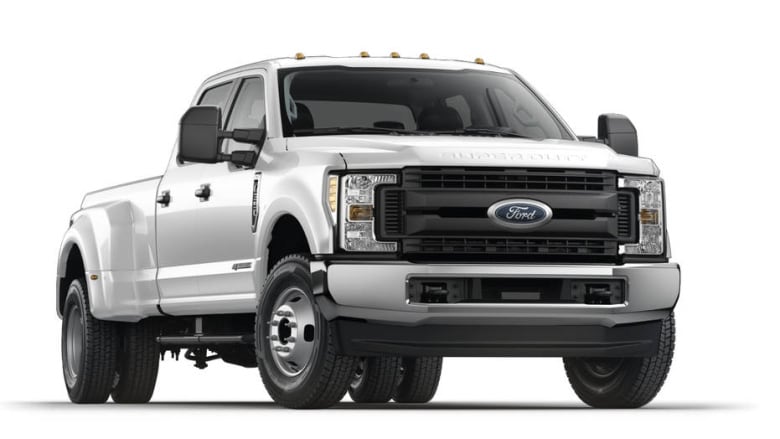
Ford is recalling more than 874,000 F-Series pickup
trucks with engine block heaters in the U.S. and Canada because they can
catch fire.
The recall covers certain F-150s from the 2015
through 2019 model years, as well as the 2017 through 2019 F-250, 350, 450
and 550.
The company says in documents posted Friday on the U.S.
National Highway Traffic Safety Administration website that water and
contaminants can get into the heater cable and cause
corrosion. That can cause electrical shorts and possible fires.
Engine block heaters warm the engines so they can start and warm up faster
in extreme cold temperatures.
Dealers will inspect and seal the cable or replace the
heaters if needed. The recall is expected to start in the U.S. on Jan. 7.
Click here to get more information on the 2-day training course on
"Corrosion in Automotive System: Causes and Prevention".
|
|
Italy Bridge Collapse -
Killing 39 People
BBC News, Thursday, August 16, 2018
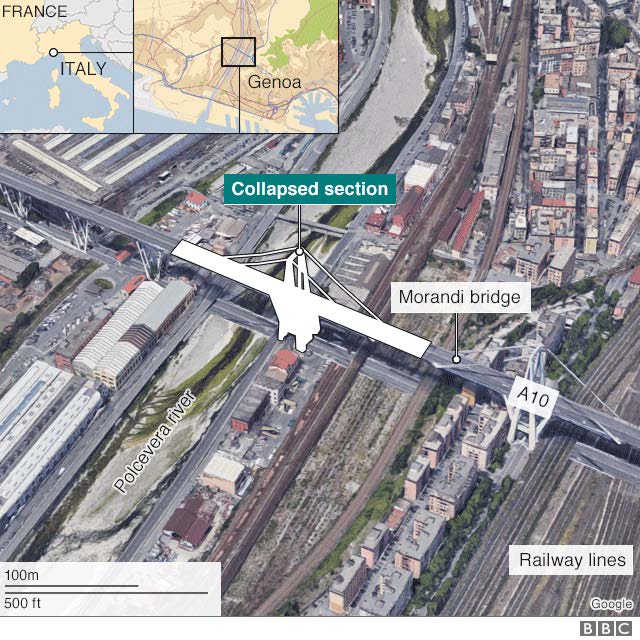
The Morandi bridge carries a major road, the A10 toll motorway, which serves
the Italian Riviera and links northern Italy to France.
Part of the 1.2km (0.8 mile) long bridge spans the Polcevera waterway, with
other portions reaching over railway lines and buildings.
A section measuring about 200m fell at around 11:30
local time (09:30 GMT) on Tuesday.
Rescuers have little hope of finding more survivors
after a motorway bridge collapsed in the Italian city of Genoa.
The local prefecture say 39 people were killed when dozens of vehicles fell
45m (148ft) from the Morandi bridge during torrential rain.
There will be a national day of mourning on Saturday to coincide with the
funerals of victims.
Click here to get more information on the 5-day training course on "An
Advanced Course in Concrete Durability".
|
|
Leaked pipe
causes water to gush up to '3 storeys high'
The Straits Times, Wednesday, September
27, 2017
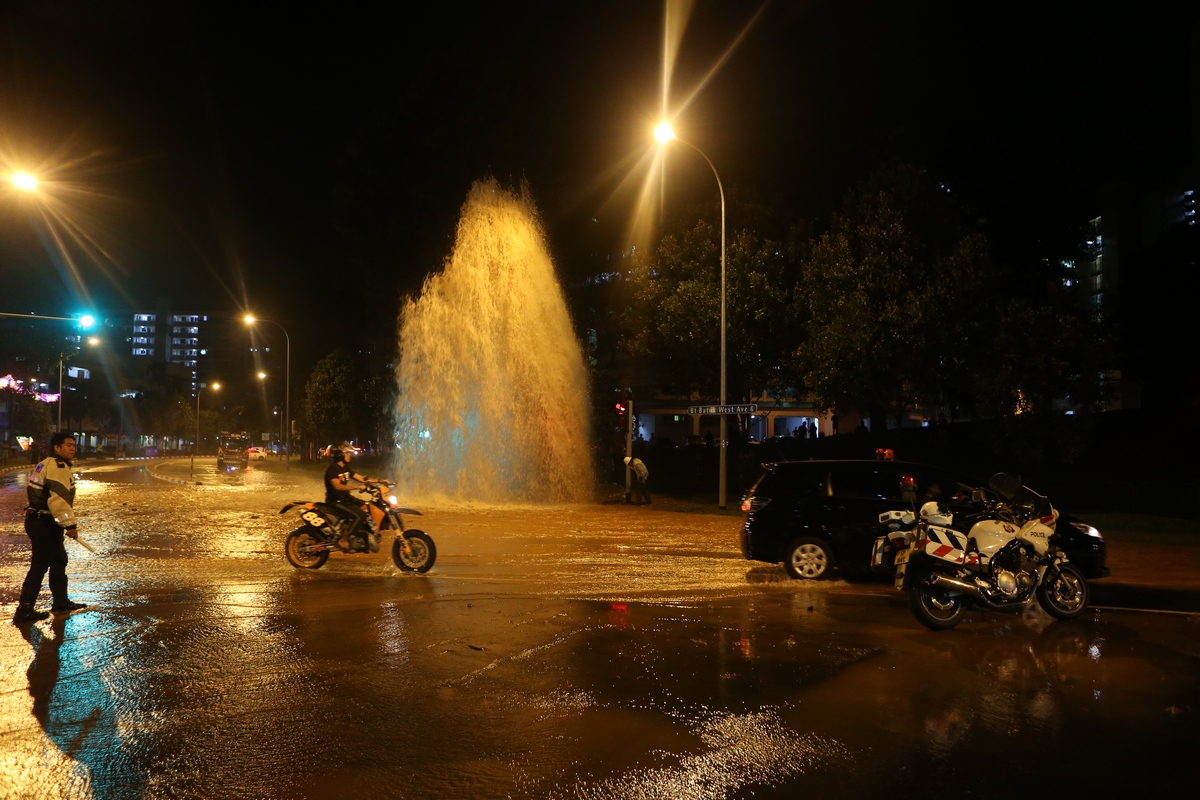
Singapore - Motorists driving by the junction of Bukit
Batok West Avenue 6 and Bukit Batok West Avenue 8 on Tuesday (Sept 26) night
were shocked to see water gushing up from the middle of the road.
Water agency PUB said that it received reports of a pipe leak at that
junction and isolated the leak with the help of the Singapore Civil Defence
Force at 1.50am on Wednesday (Sept 27).
Repair works are now underway.
Click here to get more information on the recommended training courses for
the pipeline industry.
|
|
Toyota Canada
recalls older models due to concerns of rust on suspension
The Associated Press, Friday, August 12, 2016
DETROIT -- Toyota Motor Corp. is recalling 337,000
vehicles for a third time, of which 21,722 were sold in Canada. The recall
involves the Toyota RAV4 SUV from the 2006-2011 model years and the Lexus
HS250h sedan from the 2010 model year. Toyota first recalled the vehicles in
2012 because of a wobbly rear suspension. The company recalled them again in
2013 because the nuts it used to adjust the rear wheel alignment weren't
tightened properly. This time, Toyota found that rust can form on the
suspension arm threads if the nuts for the rear wheel alignment weren't
tightened correctly. If that happens, the suspension arm could separate from
the vehicle and cause the driver to lose control. Toyota will contact known
owners of the involved vehicles and replace both rear suspension arm
assemblies for free.
|
|
Fallen Windows Due to Corrosion
of Aluminium Rivets
The Straits Times, Sunday, June 5, 2016
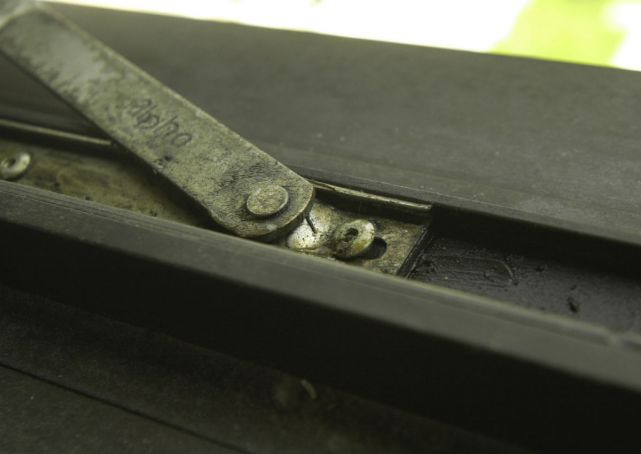
Singapore - There were 16 cases of fallen windows in
the first five months this year, the Building and Construction Authority
(BCA) said on Sunday.
Of these, 11 were casement windows and five were sliding windows. Most of
the fallen casement windows were found to have corroded aluminium rivets
which had loosened from the window stays, BCA said.
When a windows falls, homeowners responsible can be fined up to $5,000
and/or jailed up to 6 months for failing to replace aluminium rivets in
casement windows with stainless steel rivets.
If a window falls due to lack of maintenance, the homeowner responsible may
be fined up to $10,000 and/or jailed up to a year.
Since 2006, 303 people have been fined and 76 people have been prosecuted
for fallen windows.
|
|
Ford Recalls More Than 591,000
Vehicles Due to CORROSION and Nickel Plating Issues
Toronto Sun, Wednesday, April 29, 2015

DETROIT -
Ford Motor Co said on Wednesday it is recalling more than 591,000 vehicles
in North America for four separate problems, including possible broken bolts
that could make steering more difficult.
The No. 2 U.S. automaker said it is recalling 518,313 Ford Fusion and
Lincoln MKZ sedans from model years 2013-2015 and Ford Edge crossover
vehicle from 2015 model year because steering gear motor attachment bolts
may break due to corrosion. In
that case, the steering system would default to manual mode, making it more
difficult to steer, especially at lower speeds.
While no total loss of steering would occur, the problem could increase the
risk of a crash, Ford said.
Ford said it was not aware of any accidents or injuries in the recall. Of
the affected vehicles, 487,301 are in the United States and its territories,
and 31,012 in Canada.
Dealers will replace the bolts and any damaged steering gear at no cost,
Ford said. Customers located in non-corrosion states or provinces will be
covered by an extended warranty.
Ford also recalled 50,157 Ford Focus, Edge Escape and Transit Connect
vehicles from 2014 model year and Fiesta cars from 2014-2015 model years
because of a nickel plating
issue that could cause the fuel pump to seize. That could cause the vehicle
to fail to start or to stall while driving.
Ford said it was aware of one incident that may be related to this issue.
Of the recalled vehicles, 45,505 vehicles are in the United States, 4,618
are in Canada and 34 are in Mexico. Dealers will replace the fuel delivery
module.
Ford recalled 22,616 Lincoln MKZ sedans from 2015 model year because the
parking lamps may be brighter than regulations allow, adversely affecting
the vision of oncoming drivers. Of the affected vehicles, 21,435 are in the
United States, 1,066 are in Canada and 115 are in Mexico.
Dealers will update software that controls the intensity of the lamps. Ford
said it was not aware of any accidents or injuries related to the issue.
Ford also recalled 91 Ford F-150 pickup trucks from model year 2015 for
potential underbody heat shield issues that increase the risk of a fire. Of
the affected vehicles, 73 are in the United States and 18 in Canada.
Dealers will install missing parts as needed. Ford said it was not aware of
any accidents or injuries.
|
|
FAA Orders
Inspections on Boeing's 737 Aircraft
The Wall
Street Journal, Sunday, April 14, 2013
 Federal
aviation regulators on Monday will order special inspections and, if needed,
replacement of improperly manufactured parts on more than 1,000 Boeing Co.
737 jets that could cause pilots to lose control. Federal
aviation regulators on Monday will order special inspections and, if needed,
replacement of improperly manufactured parts on more than 1,000 Boeing Co.
737 jets that could cause pilots to lose control.
Industry officials said the directive is unusual because
it applies to factory defects potentially affecting such a large number of
planes, particularly relatively new versions of the most widely used
jetliner flown by carriers world-wide.
The Federal Aviation Administration's safety mandate
covers certain corrosion-prone pins used to attach movable tail panels to
the jetliner's fuselage.
The order was prompted by "reports of an incorrect
procedure used to apply the wear and corrosion protection surface coating"
to the affected parts, which the agency determined could result "in
premature failure" of the attachments and potentially "loss of control of
the airplane," the directive says.
Serious failures or structural weakness involving
horizontal stabilizer (movable tail surfaces perpendicular to rudders) potentially can be deadly because they may put planes into steep
dives or climbs that pilots may be unable to prevent.
The FAA rejected industry requests to exclude some planes
from inspections on the grounds that complex schedules for deliveries of new
aircraft and spare parts otherwise make "identification of the affected
planes difficult." The FAA estimated maximum total compliance costs at about
$10 million for U.S. carriers.
|
Five Boeing Dreamliners Need
Repair Due to Corrosion Inside the Gearbox
AFP,
Mon, 23 July 2012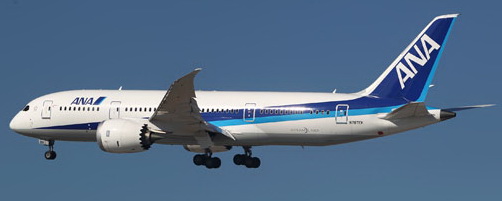
TOKYO - All Nippon Airways said Monday it was repairing five Boeing 787
Dreamliner jets for an engine defect, the latest problem for the troubled
airliner.
The Japanese carrier grounded the planes following an announcement last
week by the Dreamliner's engine manufacturer Rolls-Royce about a problem in
its gearbox, a spokeswoman said.
Two jets have since returned to service, the spokeswoman said, adding
that Rolls-Royce discovered the defect - corrosion inside the gearbox -
during endurance tests.
|
Hazardous Corrosion on Movable
Tail Parts on Boeing 757 Jets
The Wall
Street Journal, Monday, October 24, 2011
 U.S.
regulators want airlines to check for hazardous corrosion on movable tail
parts on hundreds of Boeing 757 jets that could result in pilots losing
control of aircraft. U.S.
regulators want airlines to check for hazardous corrosion on movable tail
parts on hundreds of Boeing 757 jets that could result in pilots losing
control of aircraft.
The Federal Aviation Administration proposed on Monday a mandatory safety
directive covering devices that control tail sections, called horizontal
stabilizers, that help raise and lower the noses of more than 700 Boeing
757s flown by U.S. carriers. Eventually, the checks are expected to apply to
hundreds of additional Boeing 757s operated by overseas airlines.
The move comes nearly 11 years after a maintenance lapse helped cause a
similar device to fail on the tail of an Alaska Airlines McDonnell Douglas
MD-83 off the Southern California coast, rendering the plane uncontrollable
and sending it into a dive that killed all 88 people aboard. Investigators
eventually determined that faulty aircraft design, slipshod maintenance and
inadequate federal oversight all contributed to the high-profile accident.
In 2002, the National Transportation Safety Board called on Boeing and
other aircraft makers to launch a "systematic engineering review" to prevent
such potentially catastrophic failures of flight controls on thousands of
jetliners.
Since that accident,
Chicago-based Boeing's design reviews and safety analyses found "extensive
corrosion" on one 757 that "could lead to loss of control of the horizontal
stabilizer and consequent loss of control of the airplane," according to the
FAA.
|
Nissan Recalls 600,000 Vehicles: Steering Shafts Could Crack From
Corrosion
The Vancouver Sun, Friday, 12 November 2010
 Nissan
Motor Co. is recalling about 600,000 Frontier pickup trucks and Xterra
sport-utility vehicles because their steering shafts could crack from
corrosion. No accidents have been linked with this problem, Nissan said
in a statement. Nissan said it found that the lower steering column joint
can corrode, putting limits on its movement. In extreme cases, this
can lead to the cracking of the steering shaft. The automaker received three
reports of this problem in Canada and six in Brazil. An official with Nissan
Canada said there was no information available on the number of vehicles
recalled here, but that all owners affected would be notified. Nissan
Motor Co. is recalling about 600,000 Frontier pickup trucks and Xterra
sport-utility vehicles because their steering shafts could crack from
corrosion. No accidents have been linked with this problem, Nissan said
in a statement. Nissan said it found that the lower steering column joint
can corrode, putting limits on its movement. In extreme cases, this
can lead to the cracking of the steering shaft. The automaker received three
reports of this problem in Canada and six in Brazil. An official with Nissan
Canada said there was no information available on the number of vehicles
recalled here, but that all owners affected would be notified.
The affected cars were manufactured at Nissan's plant in Smyrna,
Tennessee, between July 2001 and January 2005 and at its Curitiba, Brazil,
plant from November 2001 to June 2008. Additionally, the automaker is
recalling about 18,500 Sentra sedans due to a faulty battery connection that
could make starting the cars difficult and cause stalling at low speeds.
|
|
Problems Spring
Up for 2003-6 Saab 9-3s
The New
York Times, April 2, 2010
 General
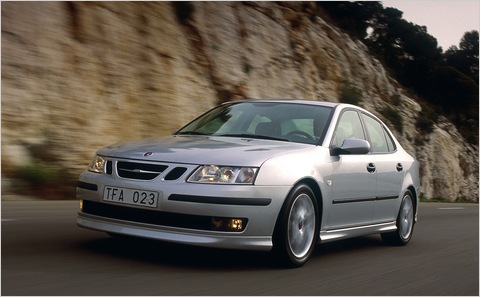
Motors is offering an extended warranty on about 66,000 2003-6 Saab 9-3s to
cover the cost of replacing front springs that break due to corrosion. General
Motors is offering an extended warranty on about 66,000 2003-6 Saab 9-3s to
cover the cost of replacing front springs that break due to corrosion.
The new warranty is 10 years or
120,000 miles, whichever comes first, according to a February letter sent to
owners. It also says owners who already paid are eligible for
reimbursement.
Alan Adler, a G.M. spokesman,
said the letter was sent to owners in Canada and states that use a lot of
road salt. Those were Connecticut, Delaware, Illinois, Indiana, Iowa, Maine,
Maryland, Massachusetts, Michigan, Minnesota, Missouri, New Hampshire, New
Jersey, New York, Ohio, Pennsylvania, Rhode Island, Washington, D.C.,
Vermont, West Virginia, and Wisconsin
|
Falling Concrete Slab Kills Woman at Montreal Restaurant
CTV News Montreal, Friday, 17 July 2009
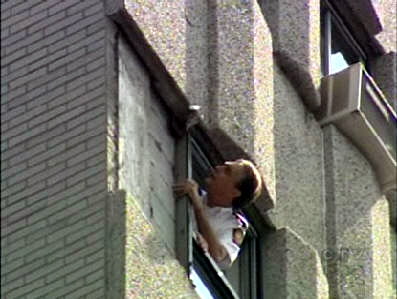 It
was supposed to be a quiet, romantic dinner for Lea Guilbeault and Hani
Beitinjaneh, who were enjoying a summer evening at the Mikasa Sushi Bar on
Peel St. in the heart of downtown Montreal. Instead, Beitinjaneh was left
shocked and horrified Thursday evening as a concrete slab fell from high
above, crashing through the atrium window of the restaurant and falling on
his 33-year-old wife, killing her instantly. It
was supposed to be a quiet, romantic dinner for Lea Guilbeault and Hani
Beitinjaneh, who were enjoying a summer evening at the Mikasa Sushi Bar on
Peel St. in the heart of downtown Montreal. Instead, Beitinjaneh was left
shocked and horrified Thursday evening as a concrete slab fell from high
above, crashing through the atrium window of the restaurant and falling on
his 33-year-old wife, killing her instantly.
The slab of concrete fell from the 18th floor of the
Marriott Residence Inn, smashing through the ceiling of the enclosed glass
section of the restaurant, located at street level. "It hit the woman right
on the head, and her head was smashed..." said Kali Subramanian, a witness
who became emotional while describing what he saw. "It's sad...it's a sad
way to die. Somebody eating at a restaurant, and it happens like that."
How did it happen?
Hellen Christodoulou, an engineer, told CTV News the concrete may have
fallen because of corrosion or water seepage.
|
Rusty Containers Lead to US$8 million Court Claim
The Straits Times, Tuesday, 13 January 2009
Mainboard-listed United Engineers (UE) told the High
Court yesterday that Steel Trading, a unit of Goodpack, has not paid for the
intermediate bulk containers which are used to transport various forms of
cargo. But Steel Trading is counter-claiming US$8 million, alleging in court
documents that many of the containers were rusty. The containers - several
of which can fit into a standard shipping container - were made by UE's
Indonesian unit, PT United Engineers Indonesia.
Steel Trading said the rust had left cargo such as fruit
or rubber contaminated. UE denies the allegations. The agreements to build
the containers were terminated in 2005. Steel Trading later complained to PT
United Engineers that 13,490 containers were rusty.
|
Why Did the Bridge Fall?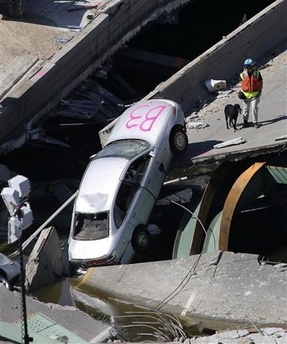
Time Thursday, 2 August 2007
It may take several days to figure out how many people
died in Wednesday's collapse of the I-35W bridge in
Minneapolis yesterday - the official toll still stands at four, but
nobody expects it to stay there. Between 20 and 30 people are still missing,
and while some of them may be lying in hospitals, unconscious and
unidentified, plenty of cars are still submerged in the
Mississippi River. Anyone trapped inside - and there are such people
- are no longer alive. So recovery crews are picking their way carefully
around the twisted steel and broken concrete that could shift without
warning in the muddy current.
Investigators, meanwhile, from the
National Transportation Safety Board (NTSB) and from a private firm
of forensic engineers hired by the state of Minnesota, have already arrived
to begin trying to figure out what happened. That might not be easy.
Sometimes a bridge collapses for glaringly obvious reasons - being whacked
by a barge, for example. That's what knocked down
Florida's Sunshine Skyway bridge in 1980, killing 35 people, and the I-40
bridge near Webbers Falls, Oklahoma, in 2002, killing 14, and a causeway in
Louisiana in 1964, killing 14.
But in other cases - the
Mianus River Bridge in
Connecticut (three dead in 1983) or the Silver Bridge, spanning the
Ohio River between Ohio and West Virginia (46 dead in 1967) - the cause is far more subtle. The
former was triggered by
metal fatigue in a single steel pin: when it finally failed,
the loss of support transferred excess stress on other parts, which couldn't
handle it, failing in turn. The latter was finally traced, again, to a
single piece of metal, which had been forged with a tiny, unnoticed crack
that weakened further with
corrosion.
Corrosion may have played a role here as well: the
Minneapolis bridge - what's known as a deck
steel truss bridge - was a concrete roadway supported by gridwork of
steel. "When you use both concrete and steel like this," says William
Miller, an expert on bridge engineering at
Temple University in
Philadelphia, "there can be chemical reactions going on where these
two very different substances meet. This is especially a problem in extreme
climates where water can get into the cracks between supports, freeze and
expand and cause a huge amount of damage." Beyond that, says Miller,
"concrete is a very forgiving material, and so it can stand up to a lot of
cracking and wear. Steel on the other hand, cannot." In a place like
Minnesota, where road crews dump corrosive ice melter on roadways by
the ton in winter, the problem is even worse.
But since civil engineers know all this, how come they
didn't spot the weak points? It may well be that the real breaking point was
hidden, or simply wasn't obvious under normal inspection. In fact, as
everyone knows by now, the bridge was deemed "structurally deficient"
starting in 1990. That didn't result in an emergency repair order, but
rather an intention to replace the bridge by 2020 - not unusual, evidently,
since the designation doesn't suggest imminent danger. According to
Minnesota Gov.
Tim Pawlenty, speaking Thursday afternoon at a press conference,
there are no fewer 70,000 to 80,000 bridges in the U.S. in the same
category; at least another 80,000 are considered "functionally obsolete," or
not up to current design standards, another label that fails to testify to a
structure's safety for travel.
|
Minneapolis Bridge Collapse Killing 7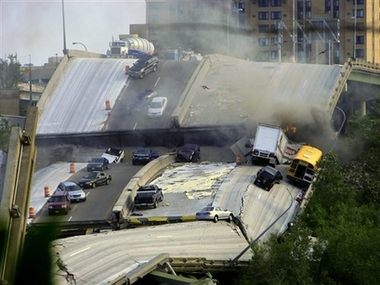
AP Wednesday, 1 August 2007
MINNEAPOLIS - An interstate bridge jammed with rush-hour traffic suddenly
broke into huge sections and collapsed into the Mississippi River Wednesday,
pitching dozens of cars 60 feet into the water and killing at least seven
people.
The steel-arched bridge, which was built in 1967, rose about 64 feet
above the river and stretched about 1,900 feet across the river. The bridge
was built with a single 458-foot-long steel arch to avoid putting any piers
in the water that might interfere with river navigation. The bridge was
scheduled for inspection this fall.
|
Sony Recalls Digital Cameras Over Metal Plating Defects
30 July 2007
30 July 2007 - Sony is recalling 416,000 digital cameras
because the case may warp, creating an edge that can cut or scratch the
user's hands. Sony has issued a safety alert about certain batches of its
"Cyber-shot" DSC-T5 digital still camera. The metal plating on the bottom of
the camera unit may warp, causing slight cuts or scratching to the skin of
the user. The metal plating of some DSC-T5 units may peel away from the
camera unit and warp outward. The adhesive strength of the
metal plating is too weak, so damage
to the bottom casing can cause the plating to peel away and warp outward.
The manufacturer is offering a free replacement of the bottom casing. Sony
says that although the metal plating of units with other serial numbers may
peel away if dropped or exposed to some other external impact, the plating
will not warp. The recall affects 350,000 Cyber Shot DSC-T5 cameras sold in
the United States, Europe and China, and about 66,000 sold in Japan, Sony
spokeswoman Ryoko Takagi said.
|
NYC explosion of steam pipe 'like a volcano'
USA Today Wednesday, 18 July 2007
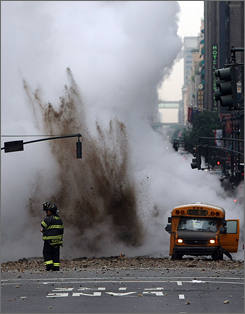 NEW
YORK — A steam pipe blew up near Grand Central Terminal on Monday and sent
thousands of people running out of buildings in a panic that it was a terror
attack. "The building started shaking. There was steam and smoke billowing
out of the ground," said Bryan Kohler, an accountant who works from a
seventh-floor office on Third Avenue. "Everybody panicked. You know what
it's like now. We grabbed our stuff and ran." NEW
YORK — A steam pipe blew up near Grand Central Terminal on Monday and sent
thousands of people running out of buildings in a panic that it was a terror
attack. "The building started shaking. There was steam and smoke billowing
out of the ground," said Bryan Kohler, an accountant who works from a
seventh-floor office on Third Avenue. "Everybody panicked. You know what
it's like now. We grabbed our stuff and ran."
The pipe blew at about 6 p.m., the height of rush hour,
and sent a geyser of mud, steam and scalding water into the air on 41st
Street, according to witnesses. White steam clouds rose as high as the
nearby 77-story Chrysler Building. One person was killed and 26 others were
wounded as the ruptured pipe sent thick plumes of smoke and ash into the
air.
New York City still uses steam to heat and cool many
buildings, including the Empire State Building. In 1989 a steam explosion
ripped through a street, killing three people. The 2-foot pipe that burst
Monday was installed in 1925.
|
CTE TUNNEL CEILING SLAB COLLAPSE LTA
to take preventive measures
The Straits Times Wednesday, 23
May 2007
CENTRAL Expressway (CTE) tunnels will now be inspected
more closely and frequently, the Land Transport Authority (LTA) said
yesterday - two weeks after a concrete slab the size of a car's bonnet fell
from a tunnel ceiling.
The checks will be carried out every three months on
stretches which are under waterways, and every six months in other areas.
Previously, the inspections were conducted once a year. The LTA said also
that it will apply an electrochemical treatment - zinc hydrogel anode - to
tunnels located under waterways. The zinc reacts with the steel in the
concrete to form a weak electrical current - as in a battery - which helps
impede corrosion. On the evening of May 9, chunks of concrete from the
ceiling of a south-bound tunnel, which goes under the Singapore River - fell
onto the road. Miraculously, no vehicles were hit. The cause has been
identified as concrete spalling, which happens when steel beams in concrete
rust and expand. The tunnels have been troubled with water seepage since the
CTE opened in 1991, though millions of dollars have been spent to arrest
leaks at nearly 2,000 points.
Yesterday, the LTA reiterated that the tunnels are
structurally safe. It said that spalling "will not lead to a reduction in
strength of the structure if attended to with proper repairs". However,
certified corrosion specialist Qiu Jianhai told The Straits Times that "spalling
concrete is just a visible surface problem signalling the start of the
deterioration of the structure". He said that if corrosion control had been
incorporated at the point of construction, it would have been cheaper. Dr
Qiu, incidentally, also advocated the zinc hydrogel treatment.
|
Falling Concrete in CTE Tunnel
Engineers, MP call for thorough check
The Straits Times Friday, 11 May
2007
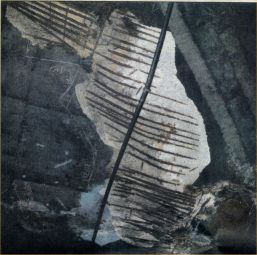 TROUBLED with leaks from the time it opened in 1991, the Central
Expressway (CTE) tunnels should be given a thorough check to prevent more
slabs of spalling concrete from smashing onto the road. This was what civil
engineers, motorists and the deputy chairman of the Government Parliamentary
Committee (GPC) for Transport said yesterday, after chunks of concrete came
crashing down around 8pm on Wednesday. TROUBLED with leaks from the time it opened in 1991, the Central
Expressway (CTE) tunnels should be given a thorough check to prevent more
slabs of spalling concrete from smashing onto the road. This was what civil
engineers, motorists and the deputy chairman of the Government Parliamentary
Committee (GPC) for Transport said yesterday, after chunks of concrete came
crashing down around 8pm on Wednesday.
This happened on the southbound CTE tunnel towards the
Ayer Rajah Expressway, near the Havelock exit - a stretch that is built
under the Singapore River. Miraculously, the slabs did not hit any vehicle
at what is usually a fairly busy time of day in the tunnel. The Land
Transport Authority (LTA) says the tunnel was safe and Wednesday's incident
was "an isolated one". LTA chief engineer Paul Fok said checks are done
regularly to spot and fix any defects. On top of that, professional
engineers inspect all tunnels "at least once every five years" to certify
their structural integrity. He added: "The structural integrity of the CTE
tunnels is not affected. We have checked the surrounding areas and found no
areas of concern." The authorities have insisted that leaks are common in
tunnels the world over, although tunnel builders that The Straits Times
spoke to say that watertight tunnels are feasible to construct. "There are
sections of MRT tunnels here that are dry, even those going under rivers.
But others leak," said a construction source. "It all depends on time, cost
and the quality of people who designed and built the project."
|
'Why wasn't pipeline pigged?'
Anchorage Daily News, 14 Oct. 2006
Alaska's congressional delegation on Friday
grilled BP executives and government regulators about Prudhoe Bay oil leaks
and, in particular, this week's revelation that state officials had ordered
BP to clean sludge out of key pipelines in 2002 but let the company off the
hook three months later.
Federal pipeline regulators believe the sludge
that BP allowed to accumulate inside the pipes for many years might have
harbored corrosives that ate holes through the steel, leading to a
201,000-gallon oil spill last winter and a second leak in early August that
forced an emergency partial shutdown of the nation's largest oil field. |
|
BP TRIAL:
Browne called to testify over refinery blast
Financial Times, 18 Sept. 2006
Plaintiffs' lawyers who earlier agreed not to call Lord Browne, BP's chief
executive, to testify in the civil cases arising from last year's fatal
Texas refinery explosion, said they now intended to question the head of the
UK oil group.
Mr Buzbee said he would ask Lord Browne about BP's
practices across the US, including Alaska, where the company had to shut
half its oilfield because of severe corrosion,
to determine whether the company has a pattern of neglect, underfunding and
underinvestment. There is a whole bevy of topics I want to bring up with
Lord Browne, Mr Buzbee said. |
|
Corrosive insulating paper triggered
Sony's third laptop battery recall
The Straits Times Wednesday, 20
September 2006
TOSHIBA said yesterday that it will replace 340,000
faulty laptop batteries worldwide, in the third recall in two months
involving Sony-made batteries. The latest recall brings the total number of
Sony batteries recalled this year to about six million worldwide.
A Sony spokesman said the batteries involved in the
latest Toshiba recall suffer from a different problem, caused by the
corrosive effects of the insulating paper
used in the battery packs. |
|
Shell pays up
after water gets into vehicles' fuel tanks
The Straits Times Tuesday, 29
August 2006
FIVE vehicles which pulled into a Shell
station in Palan Jurong Kechil recently were served watered-down petrol. An
undetected puncture in an underground fuel pipe - 2mm wick and likely
the result of corrosion - caused a
substantial amount of water in the soil to get into the pump.
Vehicles which took in the adulterated petrol - four cars
and a motorcycle - suffered varying degree of damages. For one owner,
Shell agreed to throw in a two-year
warranty on the car - on top of the three-year new-car warranty - and
$10,000 in compensation. |
|
Corrosion, oil spill prompt shutdown of Alaskan oil field
AP: 7 August 2006
ANCHORAGE, Alaska (AP) - BP Exploration Alaska has begun
shutting down the Prudhoe Bay oil field. The company says it has discovered
unexpectedly severe corrosion and a
small spill from an oil transit pipeline. Company officials say it will take
days to shut down the field. Once the shutdown is complete, it's expected to
reduce oil field production by 400,000 barrels a day. In a prepared
statement, BP America Chairman and President Bob Malone says the company
regrets that it's necessary to take the action. And he says the company
apologizes to the nation and to Alaska "for the adverse impacts it will
cause." Prudhoe Bay represents about half of Alaska's oil production and
about eight percent of U-S production, according to the US Energy
Information Administration. |
|
HDB's vow: Fewer defects, longer warranties
The Straits Times Wednesday, 29
September
2004
THE Housing Board has vowed to reduce the cases of spalling concrete and
water seepage in its new flats - and hopes to back it up with much longer
warranties against these defects.
Even if 1 or 2 per cent of flats have such problems, 'it's a lot', said
HDB chief executive Niam Chiang Meng during its annual report briefing on
Monday.
The board has asked a new building quality department to see how common
defects can be prevented, he said. And he has 'challenged' his staff to
eventually offer 10-year guarantees against spalling concrete and five-year
ones against water seepage.
Seepage in new flats has been an issue recently, as most home owners have
to pay the cost of repairs once the one-year defect liability period - when
faults are fixed for free - expires.
In the first six months of this year, 21 flats less than 10 years old had
spalling concrete. This is when ceilings crack when steel bars embedded in
concrete corrode and expand. Based on that figure, two out of every 10,000
such flats have the problem each year.
In the first half of this year, 372 flats less than five years old also
had water leaking through their ceilings. This works out to seven out of
every 1,000 such flats each year.
The figure for water seeping in through walls was 444, or eight out of
every 1,000 flats less than five years old each year.
|
Killer Windows: The heat is on to retrofit windows
The Straits Times Monday, 8
September 2004
A HOME owner with casement windows five years old or
more who does not change the aluminium rivets to stainless steel ones by 30
September 2005 faces a maximum fine of $5,000 or six months' jail, or both.
He also faces fines of up to $500 for each day after his conviction that
he still does not do the retrofitting. The changes were made to the Building
Control Act passed by Parliament last Wednesday.
The Act had been amended in 1999 to allow for a maximum penalty of $5,000
fine and six months' jail for those who did not make their air-conditioners
safe from falling by Sept 30, 2000.
With the current amendment, the Government's powers will be broadened to
include all external features of a building that could pose a danger to the
public and to impose a daily fine for those who refuse to act after a
conviction.
The new law was prompted by the rise in the number of falling windows
from just 19 in 2000 to 106 last year, mostly from HDB flats. Up until last
month, 84 cases were reported this year and all were from HDB flats.

|
Lamp post
corrosion: Three experts split
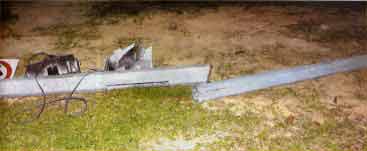
The Straits Times Tuesday, 8 June
2004
A THIRD expert witness, testifying in a
coroner's inquiry into the death of a teenager hit by a falling lamp post,
has added to the array of opinions over which part of the post was most
severely corroded.
Associate Professor Qiu Jianhai, 41, a corrosion expert
from the Nanyang Technological University's School of Materials Engineering,
said corrosion occurred exactly at the
ground level.
Earlier in the inquiry, two expert witnesses had been
divided on whether the lamp post was corroded above or below ground level.
This is central to the issue of whether a person doing a visual check of the
lamp post could have seen the rusted area and taken action that might have
prevented the fatal incident.
On Feb 28 last year, secondary school student Tay Wei Yi,
13, was playing volleyball at a Tampines basketball court when the lamp post
fell and hit him on the head. A senior property officer with Tampines Town
Council's managing agent had visually checked the lamp post three weeks
before the incident but had not noticed any defects.
Dr Qiu said the most severe corrosion took place not
above or below ground, but just at ground level. The 'junction' between the
atmosphere and the soil would be the most severely corroded because of the
'wetting and drying' process due to collected rainwater, he said. |
|
LTA spends $4m to tackle CTE water leaks for third
time
The Straits Times Friday, 5 September
2003
The LTA is now spending $4 million to lick the persistent problem of
leaks that have discoloured and damaged wall surfaces, and left black gunk
at the walls' base.
This is the third time in 12 years that the Government is tackling the
problem, first spotted about a month after the tunnels opened in 1991.
Previous attempts, costing several millions, failed.
The authorities have insisted that leaks are common in tunnels and are
not dangerous, although some experts reckon water might compromise the
integrity of the steel beams in the concrete over time.
|
Sony Digital Camera DSC-P1 Battery Issue
Wednesday, 16 April 2003
Sony has released a statement on its support site about a
potential issue affecting some of its Cyber-shot DSC-P1 digital cameras. The
cameras may exhibit shorter time between charges and/or the inaccurate
indication of the need for battery recharging. The issue seems to be caused
by
corrosion on the connection
between the AC adaptor and the camera. This symptom often results from
accumulated corrosion at the connection between the supplied AC adaptor and
the DSC-P1 camera. |
|
Boy hit on head
by lamp post dies
The Straits Times Wednesday, 7
March 2003
Tay Wei Yi, the 13-year old boy who was hit on the head
by a lamp post which was fell over last week, died yesterday morning at
Changi General Hospital.
|
Tragic Collapse: Boy hit by
falling lamp post
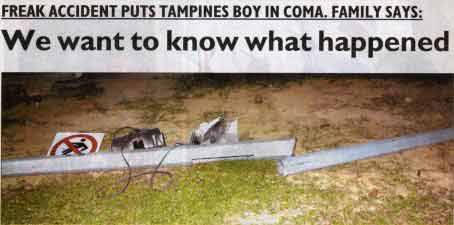
The New Paper Sunday 2 March
2003
A Tampines teenage is
fighting for his life after being hit by a falling lamp post on Friday
night.
Tay Wei Yi, 13, lies unconscious in the
intensive care ward of Changi General Hospital.
He was playing with with schoolmates at a
basketball court in Tampines when the accident happened around 7pm. A lamp
post at the side of the court collapsed without warning, knocking him to the
ground.
[WebCorr
comment: Computer modeling software,
Soil-Compass for modeling and prediction of corrosion of
metals and alloys in soil environment can provide early indication of the
metal loss due to corrosion BEFORE catastrophic failure occurs.] |
|
|
| Home
| Top | Contact
Us |
|
|