|
 |
|
Home |
Consulting |
Training |
Expert Witness |
Failure Analysis |
Design Review |
Corrosion Test |
Corrosion Software |
Protective Coatings |
Materials Selection |
Cathodic Protection |
>>> |
|
Hot Dip Galvanizing
& Mechnical Plating
- Processes, Properties and Applications |
|
Course Outline |Who Should Attend |Registration |In-House |On-Demand |Online Courses |PPT Slides+Testbank |Course List
|
Why WebCorr
|
|
Course Overview |
|
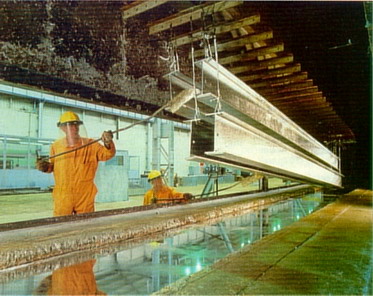 This 3-day short course systematically and thoroughly covers every aspect of hot
dip galvanizing and mechanical plating, from the process to the properties and applications of
galvanized coatings and mechanical plating. The course covers design, specification, painting
of galvanic steel surfaces, fabrication methods including bolting and
welding, inspection, coating life prediction, maintenance and repair of
galvanized products. The course will help designers, specifiers,
materials engineers, consultants, and fabricators to protect and improve
their steel products. This corrosion short course can be taken as
in-house training course, online course and distance learning course
worldwide. It can also be customized to meet the specific needs of your
organization. This 3-day short course systematically and thoroughly covers every aspect of hot
dip galvanizing and mechanical plating, from the process to the properties and applications of
galvanized coatings and mechanical plating. The course covers design, specification, painting
of galvanic steel surfaces, fabrication methods including bolting and
welding, inspection, coating life prediction, maintenance and repair of
galvanized products. The course will help designers, specifiers,
materials engineers, consultants, and fabricators to protect and improve
their steel products. This corrosion short course can be taken as
in-house training course, online course and distance learning course
worldwide. It can also be customized to meet the specific needs of your
organization.
|
|
|
|
Course Outline |
|
|
1 Corrosion & The Need for Galvanizing
1.1 The economic, social, political and environmental impacts
1.2 Liabilities due to corrosion
1.3 History of galvanizing
1.4 Basic
concepts in corrosion
1.5 Terminologies and conventions
1.6 Why do metals corrode
1.7 How do metals corrode
1.9 Corrosion prevention methods
1.10 Galvanic corrosion and properties of zinc and steel
1.11 Cathodic protection
1.12 The need for galvanizing
2
Process, Properties and Applications
2.1 Galvanizing fundamentals
2.1.1
The different galvanizing processes
2.1.2
Galvanized coating characteristics
2.2 Principles of venting
2.3 Basic venting rules
2.4 Principles of draining
2.5 Basic draining rules
2.6 Principles of avoiding distortion
2.7 Galvanizing rules to avoid distortion
2.8 Basic rules - design for galvanizing
2.9 Metallurgy of the galvanizing process
2.10 Factors affecting galvanizing quality and service
2.10.1 Steel
surface condition
2.10.2 Steel
metallurgy
2.10.3 Weld quality
2.11 Mechanical properties of galvanized coatings
2.11.1 Strength and
ductility
2.11.2
Embrittlement
2.11.3 Fatigue
strength
2.12 Other metallic zinc coatings for steel
2.13 Continuous galvanizing processes
2.14 Protective life of zinc coatings
2.14.1 Performance
in various environments
2.14.2
Compatibility of galvanized coatings with various media
2.14.3 Transport
and storage of galvanized products
2.14.4 Surface
(iron) contamination of galvanized products
2.14.5 Protection
of cut edges and damaged areas
2.14.6 Corrosion
rate of galvanized coatings
2.15 Reliability of coatings for steel
2.16 Galvanized coatings for buildings and structural steel
2.17 Galvanizing of fasteners and small components
2.20 Marking for identification
2.21 Properties and applications of
Zn-Al-Mg-Si
alloy hot-dip galvanized coatings
3
Design, Specification and Inspection of Galvanized Products
3.1 Size and shape of articles to be galvanized
3.2 Materials suitable for galvanizing
3.3 Design and fabrication of components for galvanizing
3.4 Dimensional stability
3.5 Galvanized coatings on threaded parts
3.6 Galvanized coatings on moving parts
3.7 Design for maximum corrosion protection
3.8 Metallurgical aspect of design
3.9 Inspection of work before dispatch to galvanizer
3.10 Standard specification for hot dip galvanized coatings
3.11 Standards for galvanized products
3.12 Inspection of galvanized products
3.12.1 Hot dip
galvanized coating defects: causes and remedies
3.12.2 Steel
defects and their effects on galvanized coatings
3.12.3 Defects in
paint coatings
3.13 Variations in appearance and their relationship to coating
quality
3.14 Non-destructive testing for coating thickness
3.15 Reconditioning damaged galvanized surfaces
4
Bolting Galvanized Steel
4.1 Zinc coating for fasteners
4.2 Influence of galvanized coatings on design
4.3 Slip factors
4.4 Structural bolts and bolting technique
4.5 Design for bolted structural joints
4.6 Applications of high strength bolts
4.7 Tightening procedures for high strength bolts
4.8 Inspection of high strength bolted joints
5 Welding Galvanized Steel
5.1 GMA welding
5.1.1 Effect of welding
position
5.1.2 GMA braze welding
5.1.3 GMA spot welding
5.2 Manual metal arc welding
5.3 GTA welding
5.4 Carbon arc welding
5.5 Torch welding
5.6 Reconditioning weld-damaged surfaces
5.7 Welding fumes
6 Painting Galvanized Steel
6.1 Painting galvanized steel - duplex coatings
6.2 Economics of painting galvanized steel
6.3 Synergistic effect of duplex systems
6.4 Painting procedures
6.5 Adhesion
6.6 Preparation of galvanized surfaces for painting
6.7 Pretreatment systems
6.8 Specialized primers
6.9 Finish coats
6.10 Painting recommendations
7 Mechanical Plating
7.1 Introduction to
Mechanical Plating
7.2 Hydrogen Embrittlement and Mechanical Plating
7.3 Mechanical Plating Process Description
7.4 Typical Process Sequence for Mechanical Plating
7.5 Barrel Loading Capacity for Typical Parts
7.6 Mechanical Plating Typical Cycle
7.7 Parts Suitable for Mechanical Plating
7.8 Typical Mechanical Plating Layout
7.9 Mechanical Plating Equipment
7.10 Budgetary Costs for Mechanical Plating Systems
7.11 Automation for Mechanical Plating
7.12 Post-treatments for Mechanical Plating
8 Glossary of
Galvanizing Terms
9 End-of-Course Exam
|
|
Course Outline |Who Should Attend |Registration |In-House |On-Demand |Online Courses |PPT Slides+Testbank |Course List
|
|
Who Should Attend |
|
-
Hot-dip galvanizing operators who are concerned with the operation issues in
ho-dip galvanizing.
-
Designers, specifiers, materials engineers, consultants, and fabricators who
are concerned with corrosion of steel and are interested in hot-dip
galvanizing technology for protecting steel products.
-
Engineers and technicians who are involved in testing, inspection, analysis
of galvanized steel products.
-
Users of galvanized steel products who are concerned with the performance
and durability of hot-dip galvanized steel.
|
|
Registration
for This Corrosion Course |
-
Click
here to register for this corrosion course online,
or
-
Click
here to download this corrosion course brochure with
registration form in PDF format.
|
|
In-House Training Corrosion Courses |
|
If you are concerned with corrosion in your
business, in-house training is a great solution to train a group of
employees from design, production, operation, quality assurance, inspection
and maintenance, and technical sales and support on corrosion control and
corrosion prevention technology. The contents of all corrosion courses can
be customized to fit your organization's needs.
There is no minimum or maximum number of participants required for
in-house training corrosion courses. We conduct the in-house training
corrosion course at your company's premises and at a time convenient to
your company. Requests for in-house training corrosion courses from overseas countries are also welcome.
Click
here to contact us
for a quotation. |
|
Corrosion
Course-On-Demand |
|
All our publicly scheduled corrosion short courses are conducted once a year. However, you do not need to wait for one year if you have missed any of the publicly scheduled corrosion courses as we have this unique corrosion course-on-demand scheme: we will conduct the course just for you on an one-on-one basis at a time and in a location convenient to you. This option costs significantly less than a full-scale in-house training program.
Click
here to contact us for a quotation for
taking this course as course-on-demand.
|
|
Online and Distance Learning Corrosion
Courses |
|
All corrosion courses can be conducted
through online or distance learning. An username and password will be
emailed to course participants for accessing the online course
materials. Alternatively, a CD-ROM containing the same online course
material or a master hard copy of corrosion course notes can be
sent to your organization. Instructions,
course assignments, discussions and questions related to the corrosion courses
are posted on the website. Free email support for online courses is
provided for a period up
to 12 months. A Certificate of Completion will be issued to participants
who pass the online test with a score of 70% and above.
Click
here to register this
corrosion short course for online or distance learning. |
|
|
|
PowerPoint Slides and Test Banks for Trainers,
Instructors, Tutors, University Lecturers and Professors |
|
If you are involved in teaching or
training, you may wish to purchase a complete set of the trainer's
package for this training course. The trainer's
package comes complete with ready-to-use PowerPoint slides (fully
editable) and test bank (with answer keys). These ready-to-use
PowerPoint slides contain high quality color photographs, illustrations,
animations, audio and video clips. The test bank contains questions
conveniently grouped into four categories: (1) true or false, (2)
multiple choice, (3) calculation, and (4) reasoning and open-ended
discussions. The trainer's package is suitable for in-house training and
university teaching (30 lecture hours). This is exactly the same package that WebCorr uses to deliver our
current training course.
The one-time lump sum fee allows your
organization to use the training package and also modify it. For
example, your organization may modify the course contents and
re-name/re-brand the course under your organization’s name. WebCorr only
retains the copyright of the original PowerPoint slides and test banks.
Click
here to contact us if you need more information on the trainer's package. |
|
Course Outline |Who Should Attend |Registration |In-House |On-Demand |Online Courses |PPT Slides+Testbank |Course List
|
|
Home |
Contact Us |
Copyright
©
1995-2024. All rights reserved. |