|
| |
|
Home | Consulting | Training | Expert Witness | Failure Analysis | Design Review | Corrosion Test | Corrosion Software | Protective Coatings | Materials Selection | Cathodic Protection | >>> | |
 Corrosion Modeling Software and Corrosion Prediction Software Series Seawater-Compass®: Modeling and Prediction of Metal Corrosion in Seawater and Other Natural Waters The Effective Software Solutions to Corrosion in Natural Waters Version 13.5
Anytime Anywhere Any Device Any OS No USB dongles No installation No Browser Plug-ins
|
|
Why WebCorr |
Performance Guarantee |
Unparalleled Functionality |
Unmatched Usability |
Any Device Any OS |
Free Training
& Support |
CorrCompass |
|
|
Overview of Seawater-Compass Seawater-Compass models and predicts the corrosion rate, the galvanic compatibility, and the remaining service life for many engineering metals and alloys in seawater and other natural waters such as brackish water, freshwater, and groundwater. Users simply enter the input parameter of salinity to differentiate the different types of natural waters. For deepwater or deep ocean corrosion modeling and prediction, users simply enter the input parameters of temperature/salinity/oxygen/velocity at the water depth of interest. Seawater-Compass is the only device and OS independent software tool on the market for the modeling and life prediction corrosion of metals and alloys including carbon steels, aluminum alloys, brass, copper-nickel alloys, nickel alloys, stainless steels, duplex stainless steels, and titanium alloys. Design engineers, engineering consultants, operation personnel, maintenance and inspection engineers can quickly and accurately determine: (1) the corrosion rate of the selected metal or alloy in seawater or other natural waters as characterized by the water salinity, dissolved oxygen, and temperature; (2) the remaining life of the equipment or component; (3) the major forms of corrosion expected under the specified service condition, (4) cautious note on:
(5) the galvanic compatibility between dissimilar metals including:
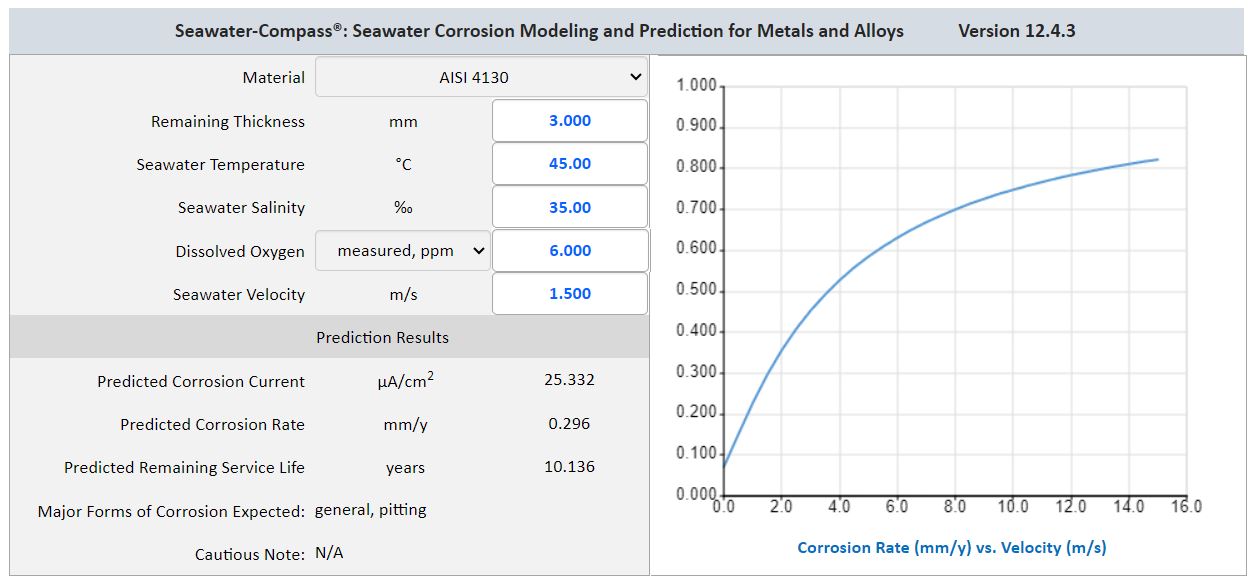
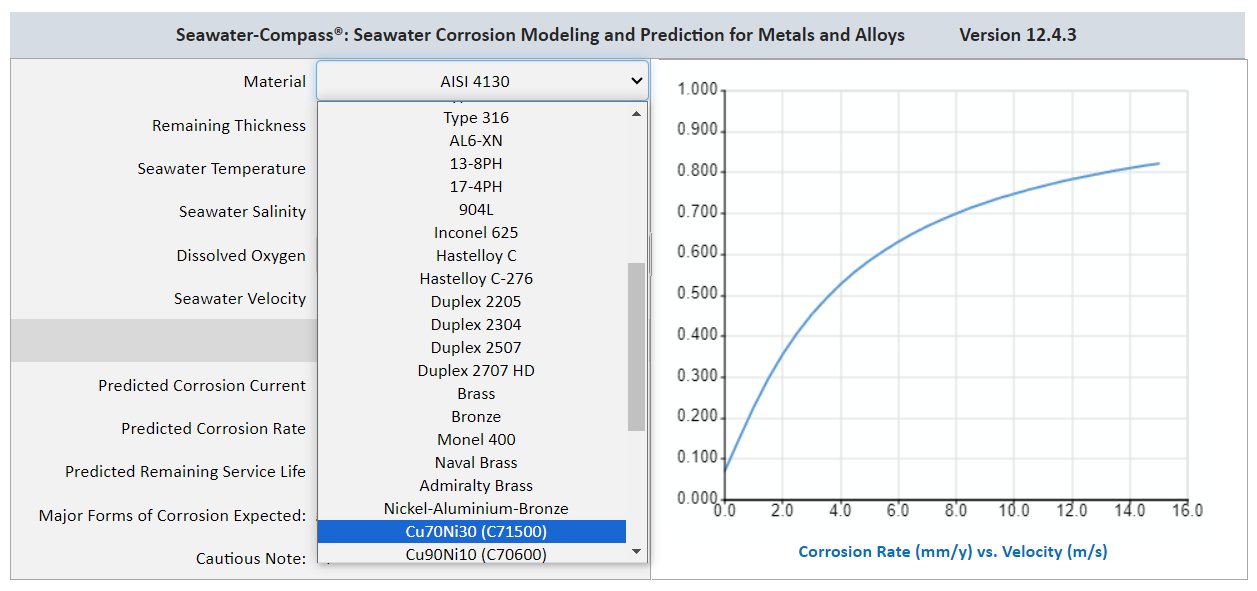
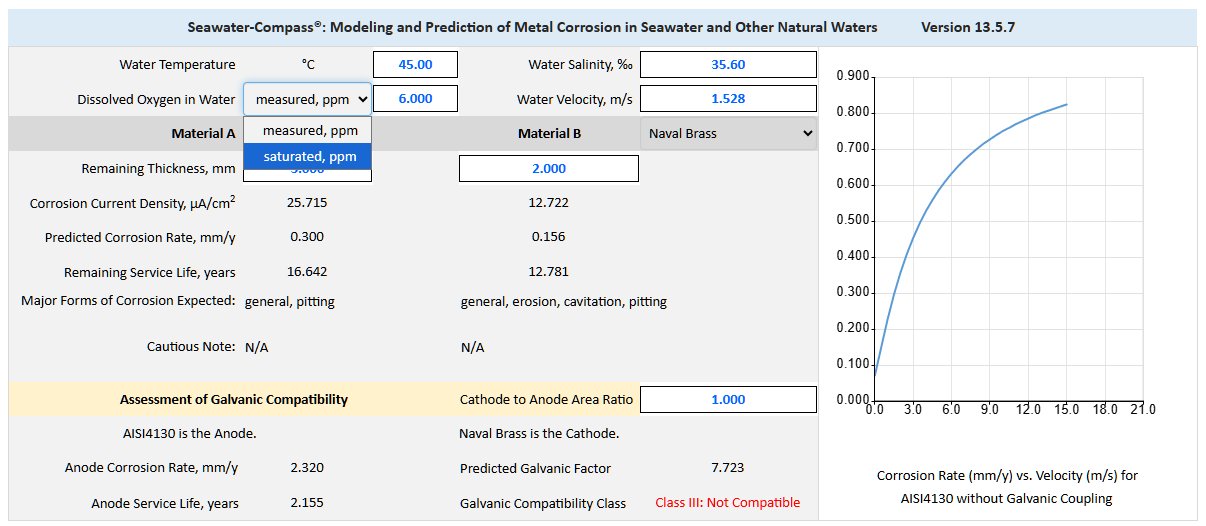
Figure 1 below shows an overview of Seawater-Compass. Users simply select one of the 50 metals and alloys from the list (Figure 2). Seawater-Compass models the effect of water temperature, water salinity, dissolved oxygen concentration, and water velocity on corrosion and predicts the corrosion rate, the galvanic compatibility, and the remaining life of equipment or component under the prevailing operating conditions with or without galvanic coupling of dissimilar metals.
Figure 1 Overview of the Seawater-Compass for Predictive Modeling of Seawater Corrosion of Metals and Alloys
Seawater-Compass is a cloud-based software that works on any device running any OS without the need for users to install or download anything. Experience the industry's first cross-platform and device-independent seawater corrosion modeling and prediction app on your iPads, tablets, smart phones, notebooks and desktops, at any time and anywhere, in the office or in the field. No installation files to download, no browser plug-ins required, no USB dongles to carry around, and no license keys to transfer from one PC to another. Seawater-Compass simply works on any device running any OS. All you need is an internet browser.
In the application example in Figure 1 above, the predicted corrosion rate of carbon steel in seawater of salinity of 35.6‰ is 0.300 mm/y at the operating temperature of 45°C with 6 ppm DO, and seawater velocity of 1.528 m/s. Seawater-Compass predicts that the major forms of corrosion expected are general attack and pitting under the prevailing operating conditions for AISI4130 and erosion and cavitation for Naval Brass.
Figure 2 Seawater-Compass: A Predictive Corrosion Software Tool for Materials Selection for Seawater Services
Using Seawater-Compass is as easy as 1-2-3.
(1) Select the material from the dropdown list and enter the design data (Figures 1 & 2)
(2) Enter the water temperature, salinity, dissolved oxygen, and water
velocity
(3) Review the prediction results
Seawater-Compass has the following materials in the selection list. If you cannot find the material of your interest, contact us and we will conduct the necessary tests and add that material to the selection list, free of charge for licensed users.
AA1100
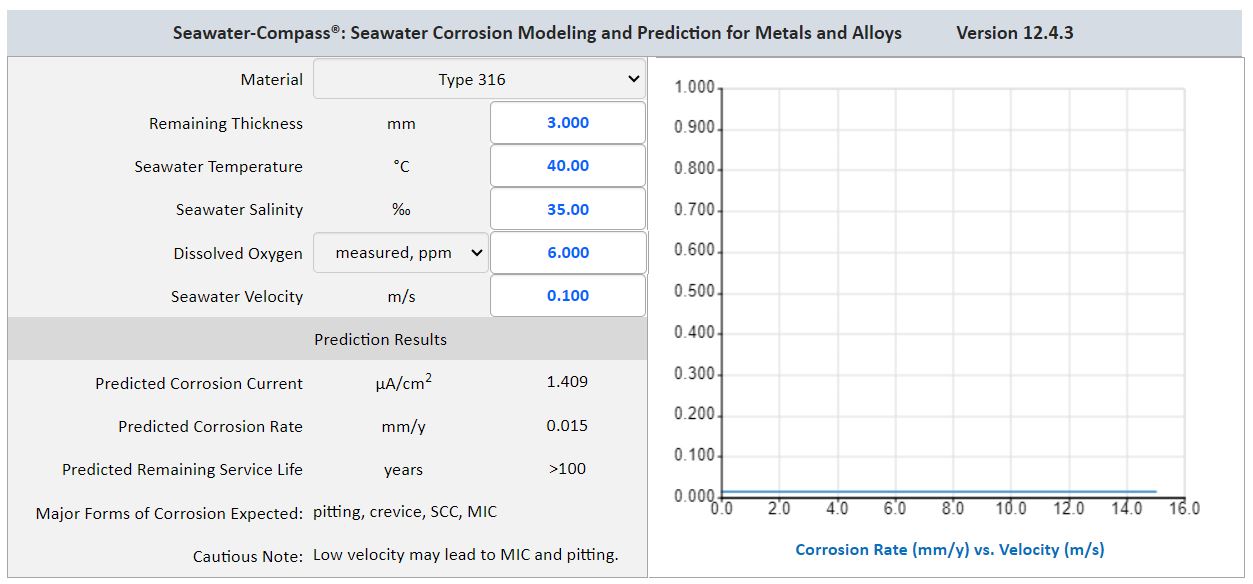
Figure 3 Seawater-Compass predicts the risk of pitting and microbiologically-influenced corrosion (MIC) under low flow or stagnant condition.
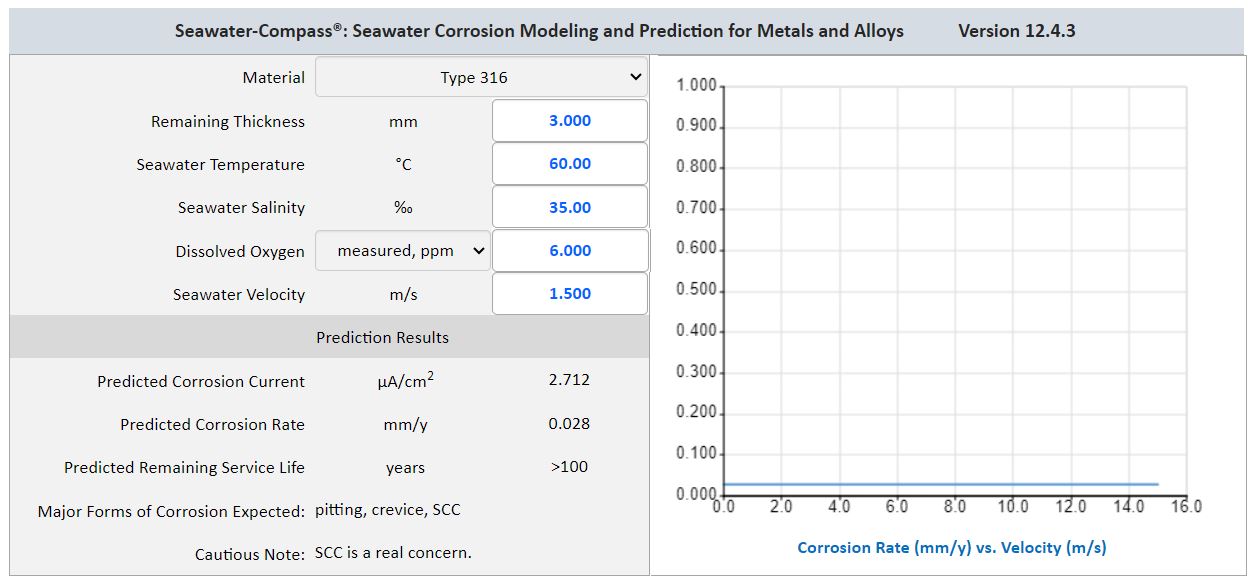
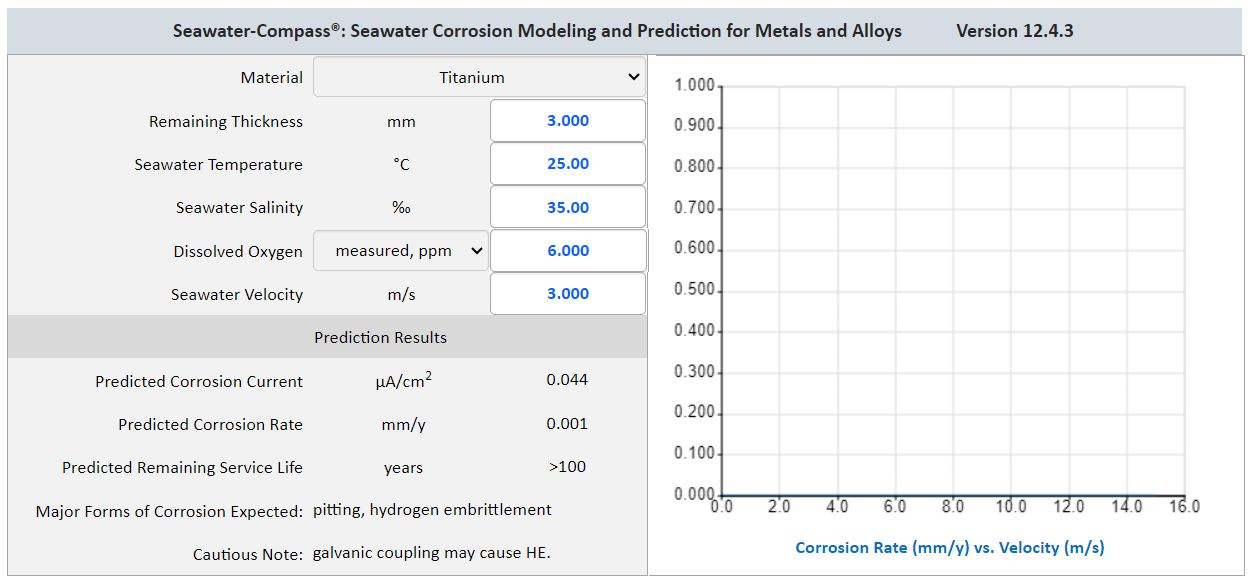
In Figure 3 above, the seawater velocity is low, at 0.1 m/s. Seawater-Compass predicts the risk of pitting and MIC with a cautious note for the user. In Figure 4 below, the seawater temperature is high at 60°C, Seawater-Compass predicts the risk of chloride stress corrosion cracking (SCC) for type 316 stainless steel. In Figure 5, Seawater-Compass predicts the risk of hydrogen embrittlement for titanium in seawater services.
Figure 4 Seawater-Compass predicts the risk of stress corrosion cracking (SCC) of austenitic stainless steels in seawater services.
Figure 5 Seawater-Compass predicts the risk of hydrogen embrittlement (HE) of Titanium in seawater services.
Seawater-Compass models the effect of dissolved oxygen on the corrosion rates of metals and alloys (Figure 6). Users of Seawater-Compass software can enter the measured values or choose the saturated option to let the software compute the solubility of oxygen under the prevailing temperature and water salinity.
Figure 6 Seawater-Compass models the effect of dissolved oxygen on corrosion. The powerful applications of Seawater-Compass are truly unlimited in engineering design, materials selection, process operation, inspection and maintenance, corrosion risk assessment, setting the IOW limits, corrosion modeling and remaining life prediction. Click here to contact us for licensing details and experience the power of Seawater-Compass. |
|
|
Seawater-Compass, giving you the right directions in Seawater Corrosion Modeling and Prediction. |
|
|
Home | Contact Us | PDF |
Copyright © 1995-2026. WebCorr Corrosion Consulting Services. All rights reserved. |

 Performance