|
| |
|
Home | Consulting | Training | Expert Witness | Failure Analysis | Design Review | Corrosion Test | Corrosion Software | Protective Coatings | Materials Selection | Cathodic Protection | >>> | |
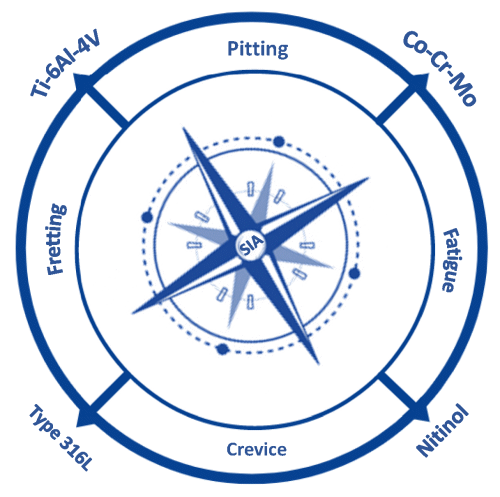 Corrosion Modeling Software and Corrosion Prediction Software Series SIA-Compass®: A Software Tool for Modeling and Prediction of Corrosion of Surgical Implant Alloys in the Human Body Protecting people, assets, and the environment from the harmful effect of corrosion Version 13.5
Anytime Anywhere Any Device Any OS No USB dongles No installation No Browser Plug-ins
|
|
|
Why WebCorr |
Performance Guarantee |
Unparalleled Functionality |
Unmatched Usability |
Any Device Any OS |
Free Training
& Support |
CorrCompass |
|
|
|
|
|
Surgical implant alloys are a group of biocompatible metals and alloys approved by the FDA for use in the human body to repair, replace, or augment tissues and structures. Corrosion of these metals and alloys in the human body has always been a concern as corrosion can lead to either the failure of the implant to function as it was intended, or have an adverse effect on the patient resulting in the rejection of the implant by the surrounding tissue, or both. Any surgical implant alloy is regarded as a foreign body, the safety and potential effect of foreign material on the human health cannot be ignored. Metal ions released as a result of corrosion are potentially toxic and carcinogenic. Based on the data by the International Agency for Research on Cancer (IARC), Cr(6+) and Ni(2+) are carcinogenic for humans (IARC Group 1), and metal Ni and dissolved Co are possibly carcinogenic (IARC Group 2B). Knowing the corrosion rate and the dominating form of corrosion for a candidate implant alloy will help healthcare providers to assess the potential risks to patients. SIA-Compass is the only device and OS independent software tool on the market for the modeling and prediction of corrosion of surgical implant alloys. Healthcare providers and patients can quickly assess and quantify the corrosion performance of the selected implant alloy anytime, anywhere, on any device running any OS without the need to install or download anything (Figure 1).
Figure 1 SIA-Compass Models and Predicts Corrosion of Surgical Implant Alloys.
SIA-Compass predicts the following corrosion properties for the selected implant alloy (Figure 1): (a) corrosion potential (b) critical pitting potential (c) corrosion current density (d) corrosion rate (e) major forms of corrosion
For galvanically coupled alloys, SIA-Compass models the effect of cathode-to-anode area ratio and predicts the galvanic compatibility of the selected alloys (Figure 1) with the following outputs: (a) potential of the galvanic couple (b) galvanic current density (c) galvanic acceleration factor (d) anode corrosion rate (e) remaining service life (f) galvanic compatibility class
The implant alloys in SIA-Compass (Figure 2) include the following:
Type 316L
Figure 2 SIA-Compass Models and Predicts Corrosion of Surgical Implant Alloys.
If you cannot find the metal or alloy of your interest in the
above list, do let us know through the
Contact Us link and we will conduct the necessary
research to generate the required data for inclusion in the software, free of charge for licensed users of
SIA-Compass.
Click here to contact us for licensing details and experience the power of SIA-Compass. |
|
|
SIA-Compass, giving you the right directions in Modeling and Prediction of Corrosion of Surgical Implant Alloys. |
|
|
Home | Contact Us | PDF |
Copyright © 1995-2026. All rights reserved. |

 Performance