|
|
|
•Uniform •Galvanic • Dealloying • Crevice • Pitting • Intergranular • SSC • LME • MIC • SCC • HB-HE-HIC • Fatigue • Erosion • Fretting •Index |
|
Different Types of
Corrosion
|
|
|
Dealloying, Selective Leaching & Graphitic Corrosion |
|
|
Recognition of Dealloying and Graphitic Corrosion |
|
|
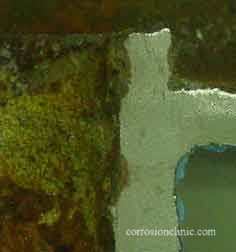
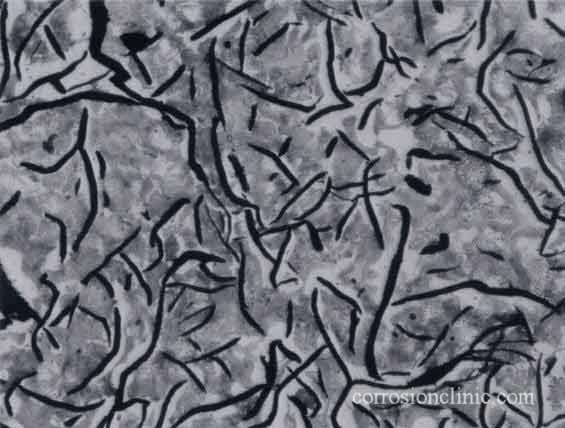
What is dealloying? Dealloying is the selective corrosion of one or more components of a solid solution alloy. It is also called parting, selective leaching or selective attack. Common dealloying examples are decarburization, decobaltification, denickelification, dezincification, and graphitic corrosion. Decarburization is the selective loss of carbon from the surface layer of a carbon-containing alloy due to reaction with one or more chemical substances in a medium that contacts the surface. Decobaltification is selective leaching of cobalt from cobalt-base alloys, such as Stellite, or from cemented carbides. Denickelification is the selective leaching of nickel from nickel-containing alloys. Most commonly observed in copper-nickel alloys after extended service in fresh water. Dezincification is the selective leaching of zinc from zinc-containing alloys. Most commonly found in copper-zinc alloys containing less than 85% copper after extended service in water containing dissolved oxygen. Graphitic corrosion is the deterioration of gray cast iron in which the metallic constituents are selectively leached or converted to corrosion products leaving the graphite intact. Graphitic corrosion should not be confused with another term graphitization, which is used to describe the formation of graphite in iron or steel, usually from decomposition of iron carbide at elevated temperatures.
|
|
|
Mechanisms
of Dealloying and Graphitic
Corrosion |
|
|
What causes dealloying? Different metals and alloys have different electrochemical potentials (or corrosion potentials) in the same electrolyte. Modern alloys contain a number of different alloying elements that exhibit different corrosion potentials. The potential difference between the alloying elements is the driving force for the preferential attack on the more "active" element in the alloy.
In the case of dezincification of brass, zinc is preferentially leached out of the copper-zinc alloy, leaving behind a copper-rich surface layer that is porous and brittle.
|
|
|
Prevention of Dealloying and Graphitic Corrosion |
|
How to prevent
dealloying? Dealloying, selective leaching and
graphitic corrosion can be prevented
through the following methods:
|
|
|
For more details on
Dealloying and Graphitic Corrosion |
|
Where can I learn more about
dealloying and graphitic corrosion? More details on dealloying, selective leaching and graphitic corrosion are included in the following
corrosion short courses which you can take as
in-house training courses,
course-on-demand, online
courses or distance
learning courses:
If you require corrosion expert witness or corrosion consulting service on dealloying and graphitic corrosion, our NACE certified Corrosion Specialist is able to help. Contact us for a quote. |
|
| Home | Go to Top | Contact Us | PDF |
Copyright © 1995-2024. All rights reserved. |