|
 |
|
Home |
Consulting |
Training |
Expert Witness |
Failure Analysis |
Design Review |
Corrosion Test |
Corrosion Software |
Protective Coatings |
Materials Selection |
Cathodic Protection |
>>> |
|
Corrosion Inspection, Corrosion Testing
and Monitoring |
|
Course Outline |Who Should Attend |Registration |In-House |On-Demand |Online Courses |PPT Slides+Testbank |Course List
|
Why WebCorr
|
|
Course Overview |
|
 Corrosion is a disease to materials just like
a disease to human beings. Some types or forms of corrosion can be prevented
through good practices in materials selection and design, while others can
be cured or controlled if diagnosed early.
Corrosion diagnosis involves a number of
destructive and non-destructive inspection and examination techniques such
as visual, NDT/NDE, inspection, chemical, electrochemical, mechanical,
metallurgical, and microstructural tests and analyses. Unexpected corrosion
failures can be avoided through
corrosion inspection, corrosion monitoring,
and corrosion testing. This corrosion short course aims to present to the technologists and engineers a dozen of
corrosion testing and monitoring techniques that can be used to solve many
of their most tedious and persistent corrosion problems. This corrosion course will
provide the participants with a thorough understanding of the basic
principles and the practical applications of some simple yet powerful
techniques in corrosion testing and monitoring. For each technique, a step
by step guide for performing the corrosion measurements will be described. This
5-day course
(with practical session) provides
an excellent avenue for corrosion practitioners, researchers, designers, technical
managers, inspection and maintenance engineers, quality control personnel and those
involved in failure analysis to update their appreciation of modern
techniques for corrosion testing and
monitoring. Corrosion is a disease to materials just like
a disease to human beings. Some types or forms of corrosion can be prevented
through good practices in materials selection and design, while others can
be cured or controlled if diagnosed early.
Corrosion diagnosis involves a number of
destructive and non-destructive inspection and examination techniques such
as visual, NDT/NDE, inspection, chemical, electrochemical, mechanical,
metallurgical, and microstructural tests and analyses. Unexpected corrosion
failures can be avoided through
corrosion inspection, corrosion monitoring,
and corrosion testing. This corrosion short course aims to present to the technologists and engineers a dozen of
corrosion testing and monitoring techniques that can be used to solve many
of their most tedious and persistent corrosion problems. This corrosion course will
provide the participants with a thorough understanding of the basic
principles and the practical applications of some simple yet powerful
techniques in corrosion testing and monitoring. For each technique, a step
by step guide for performing the corrosion measurements will be described. This
5-day course
(with practical session) provides
an excellent avenue for corrosion practitioners, researchers, designers, technical
managers, inspection and maintenance engineers, quality control personnel and those
involved in failure analysis to update their appreciation of modern
techniques for corrosion testing and
monitoring.
This corrosion short course can be taken as in-house
training course, online course and distance learning course worldwide. It can also be customized to meet the
specific needs of your organization. |
|
|
|
Course Outline |
|
This corrosion short course covers a wide range of corrosion testing and
monitoring techniques from conventional weight loss coupons, electrical
resistance (ER) and linear polarization resistance (LPR) to
advanced electrochemical impedance spectroscopy (EIS) for routine
applications such as rapid screening of corrosion inhibitors, materials
selection, failure analysis, corrosion rate measurement, life prediction,
evaluation of paints, coatings, electroplating, on-line monitoring of
industrial processes, determination of resistance to pitting and crevice
corrosion, and the degree of sensitization of stainless steels and alloys.
This course also covers six most commonly used non-destructive
techniques for corrosion inspection.
|
|
1. Basics
of Corrosion Measurements
1.1
Introduction
1.2
Corrosion and society
1.3
The
need for corrosion testing and monitoring
1.4
Terminology and conventions
1.5
Overview of
different forms of corrosion
2. Corrosion
Testing and Monitoring Techniques
2.1
Weight loss coupon
2.2
Electrical resistance (ER)
2.3
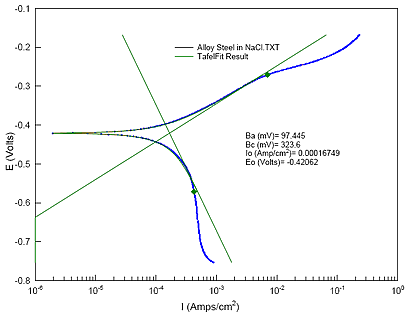
Principles of electrochemical methods and Tafel plot
2.4
linear polarisation resistance (LPR)
2.5
Potentiodynamic anodic polarisation
2.6
Cyclic polarisation for pitting test
2.7
Electrochemical potentiokinetic reactivation (EPR) for
sensitisation test
2.8
Other
techniques: electrochemical impedance spectroscopy (EIS),
electrochemical noise (EN),
zero-resistance ammetry (ZRA),
and hydrogen monitoring
3. Applications of Electrochemical Techniques
4. On-Line
Corrosion Monitoring
4.1 why
use on-line corrosion monitoring
4.2
direct methods of on-line corrosion monitoring
4.3
on-line monitoring system components and functions
4.4
principle on-line corrosion monitoring methods
4.5
where
&
when
to use it
4.6
how
much does it cost
5. Corrosion Inspection Techniques
5.1 Visual
Inspection
5.2 Liquid
Penetrant Inspection
5.3 Magnetic
Particle Inspection
5.4 Ultrasonic
Testing
5.5 Eddy Current
Testing
5.6 X-ray
Radiography
6. Software Solutions to Industrial
Corrosion: Overview of Corrosion Modeling and Corrosion
Prediction Software
-
ABC-Compass: Ammonium Bisulfide Corrosion Modeling and Life Prediction
-
ACE - Apps for Corrosion Engineers: A Collection of Essential
Corrosion Software Applications for Corrosion Engineers,
Corrosion Researchers, and Corrosion Technicians in
Laboratories and in Fields
-
ACMF-Compass: Modeling and Prediction of the Effects
of AC and Magnetic Field on Metal Corrosion
-
Atmosphere-Compass: Prediction and Modeling of Atmospheric
Corrosion of Metals and Alloys
-
CCC-Compass: Modeling and Prediction of Caustic Corrosion and Caustic
Stress Corrosion Cracking
-
CIPAL-Compass: Copper-Induced Pitting in Aluminium Alloys - Modeling, Life Prediction and Process Control
-
CO2Compass: Modeling and Prediction of Corrosion by Carbon
Dioxide (CO2), Hydrogen Sulfide (H2S), Acetic Acid (HAc), Elemental
Sulfur (S), and Mercury (Hg) in Oil and Gas Pipelines and Production
Tubing
-
Concrete-Compass: Concrete Corrosion Prediction and
Modeling
-
CP-Compass-Pipeline: Cathodic Protection Design Calculations, Verification, Assessment and Solution for Underground Pipelines
-
CP-Compass-Concrete: Design Calculations for Cathodic Protection of Reinforced Concrete Structures
-
CRA-Compass: Corrosion Modeling and Corrosion Prediction for
Corrosion Resistant Alloys - the Threshold Temperature and Chloride
Concentration for Pitting, Crevice Corrosion, and Stress Corrosion
Cracking (SCC)
-
CSR-Compass: Modeling and Remaining Life Prediction of Creep
and Stress Rupture of Boiler and Heater Tubes
-
CUI-Compass: Prediction and Risk Assessment of Corrosion Under Insulation and Fireproofing
-
Dew-Point-Compass: Prediction of Dew Point
Temperatures of Flue Gases and the Risk of Dew Point Corrosion
-
DWD-Compass: Modeling and Life Prediction of
Corrosion in Drinking Water Distribution Systems
-
EVS-Compass: Extreme Value Statistics in Corrosion Modeling and Corrosion Life Prediction
of Structures and Plant Assets
-
FAC-Compass:
Erosion Corrosion and Flow - Accelerated Corrosion Modeling, Life Prediction and Materials
Selection in Water-Steam Systems
-
FuelAsh-Compass: Fuel Ash Corrosion Modeling and Life Prediction of
Boiler and Heater Tubes
-
GC-Compass: Galvanic Corrosion Prediction and Materials Compatibility Assessment
-
H2Compass: Modeling and Prediction of Low Temperature Hydrogen Damages
(Hydrogen Blistering, Hydrogen-Induced Cracking, Hydrogen Embrittlement) and High Temperature Hydrogen Attack (HTHA)
-
H2SO4-Compass: Corrosion Prediction and Materials Selection
Guide for H2SO4 Services
-
HCl-Compass: Corrosion Prediction and Materials
Selection Guide for HCl Services
-
ISO15156-Compass: Modeling and Prediction of in-situ
pH, Region of Environmental Severity, and Susceptibility to
Sulfide Stress Cracking (SSC) of Carbon and Low Alloy Steels
-
NAC-Compass: Modeling and Prediction of High Temperature Naphthenic Acid Corrosion
-
O2Compass: Modeling and Prediction of High Temperature Oxidation
-
OCTG-Compass: Corrosion Prediction and CRA Materials
Selection Guide for Oil and Gas Production Systems
-
PipelineCompass: Pipeline Corrosion Modeling, Prediction, Assessment and Solutions
-
PCW-Compass: Corrosion Prediction and Modeling in
Process Cooling Water Systems
-
SC-Compass: Stray Current
Corrosion and AC Corrosion - Identification, Assessment and
Prediction
-
S-Compass:
Modeling and Prediction of High Temperature Sulfidation/Sulfidic
Corrosion/H2-H2S Corrosion and Low Temperature Elemental Sulfur
Corrosion
-
Seawater-Compass: Seawater Corrosion Prediction for
Metals and Alloys
-
Shipwreck-Compass: Shipwreck Corrosion Modeling and Corrosion
Prediction
-
Soil-Compass: Soil Corrosion Prediction and Modeling for
Metals and Alloys
-
VPC-Compass: Prediction and Modeling of Internal Corrosion in Vapor Phase in Closed Systems
-
VPC-Compass-SE: Prediction and Modeling of Corrosion in Microelectronic Packages
|
|
Course Outline |Who Should Attend |Registration |In-House |On-Demand |Online Courses |PPT Slides+Testbank |Course List
|
|
Who Should Attend
This Corrosion Testing and Monitoring Course |
|
Corrosion practitioners, researchers, designers, technical managers, inspection
and maintenance engineers, quality control personnel and those involved in
failure analysis.
Successful completion of this corrosion course helps participants
prepare for their NACE certification examinations at the Corrosion Technician,
Corrosion Technologist and Senior Corrosion Technologist levels.
|
|
Registration
for This Corrosion Course |
|
Click
here to register for this corrosion course online,
or
Click
here to download this corrosion course brochure with
registration form in PDF format.
|
|
In-House Training Corrosion Courses and
On-Site Training Corrosion Courses |
|
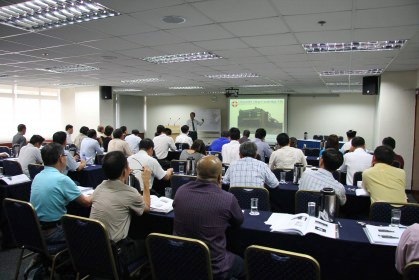 If you are concerned with corrosion in your
company, in-house training or on-site training is a great solution to train a group of
employees from design, production, operation, quality assurance, inspection
and maintenance, and technical sales and support on corrosion control and
corrosion prevention technology. The contents of all our corrosion courses can
be customized to fit your organization's needs. If you are concerned with corrosion in your
company, in-house training or on-site training is a great solution to train a group of
employees from design, production, operation, quality assurance, inspection
and maintenance, and technical sales and support on corrosion control and
corrosion prevention technology. The contents of all our corrosion courses can
be customized to fit your organization's needs.
There is no limit to the number of participants required for
in-house training corrosion courses. We conduct the in-house training
corrosion course at your company's premises worldwide, and at a time convenient to
your company.
Click
here to contact us
for a quotation for in-house training corrosion courses. |
|
Corrosion
Course-On-Demand |
|
 All our publicly scheduled corrosion short courses are conducted once a year. However, you do not need to wait for one year if you have missed any of the publicly scheduled corrosion courses as we have this unique corrosion course-on-demand scheme: we will conduct the course just for you
(on an one-on-one basis) or for a small group from your company at a time and in a location convenient to you. This option costs significantly less than a full-scale in-house
or on-site corrosion training program. All our publicly scheduled corrosion short courses are conducted once a year. However, you do not need to wait for one year if you have missed any of the publicly scheduled corrosion courses as we have this unique corrosion course-on-demand scheme: we will conduct the course just for you
(on an one-on-one basis) or for a small group from your company at a time and in a location convenient to you. This option costs significantly less than a full-scale in-house
or on-site corrosion training program.
Click
here to contact us for a quotation. |
|
Online
Corrosion Courses and Distance Learning Corrosion
Courses |
|
 All
our corrosion short courses are available for online or offline distance
learning. You can start an online corrosion course at any time and learn
at your own comfortable pace and schedule, whenever and wherever you
are. You have around-the-clock access to the interactive and media-rich
course materials, virtual labs, course instructions and course assessments. Discussions and questions related to the corrosion courses
are posted on the website or exchanged through email for a period up to 3 months. Video conferencing or instant messaging can also be arranged for discussions of course topics.
For those who do not have ready access to internet, we can send
you our online course materials on a CD-ROM, or DVD, or USB flash drive for offline
distance learning. All
our corrosion short courses are available for online or offline distance
learning. You can start an online corrosion course at any time and learn
at your own comfortable pace and schedule, whenever and wherever you
are. You have around-the-clock access to the interactive and media-rich
course materials, virtual labs, course instructions and course assessments. Discussions and questions related to the corrosion courses
are posted on the website or exchanged through email for a period up to 3 months. Video conferencing or instant messaging can also be arranged for discussions of course topics.
For those who do not have ready access to internet, we can send
you our online course materials on a CD-ROM, or DVD, or USB flash drive for offline
distance learning.
Click
here to to register an online corrosion short course. |
|
|
|
PowerPoint Slides and Test Banks for Trainers,
Instructors, Tutors, University Lecturers and Professors |
|
If you are involved in teaching or
training, you may wish to purchase a complete set of the trainer's
package for this training course. The trainer's
package comes complete with ready-to-use PowerPoint slides (fully
editable) and test bank (with answer keys). These ready-to-use
PowerPoint slides contain high quality color photographs, illustrations,
animations, audio and video clips. The test bank contains questions
in four categories: (1) true or false, (2)
multiple choice, (3) calculation, and (4) reasoning and open-ended
discussions. The trainer's package is suitable for in-house training and
university teaching (30 lecture hours). This is exactly the same package that WebCorr uses to deliver our
current training course.
The one-time lump sum fee allows your
organization to use the training package and also modify it. For
example, your organization may modify the course contents and
re-name/re-brand the course under your organization’s name. WebCorr only
retains the copyright of the original PowerPoint slides and test bank.
Click
here to contact us if you need more information on the trainer's package.
|
|
Course Outline |Who Should Attend |Registration |In-House |On-Demand |Online Courses |PPT Slides+Testbank |Course List
|
|
Home |
Contact Us |
Copyright
©
1995-2024. All rights reserved. |